Written by: Martins Cornelius
Medically reviewed by: Dr. Henry Oliver
Last reviewed: April 6, 2026
If you’re just starting, most beginners do best with 3 to 4 workout days a week. That’s usually enough to improve fitness, build strength, and recover properly without making exercise feel overwhelming. According to the CDC, Mayo Clinic, and the NHS, adults should aim for at least 150 minutes of moderate activity each week and do muscle-strengthening activity at least 2 days a week.
That does not mean you need to train hard four days every week from day one. A lot of beginners make the mistake of copying routines built for fitter people instead of starting with a schedule they can actually recover from. Most beginners do better with a balanced week that includes a few real workouts, lighter movement on easier days, and enough recovery for the body to adapt. The CDC explains that weekly activity can be broken into smaller sessions, so workouts do not need to be long to count.
Click to Jump
The short answer
Most beginners should work out 3 to 4 times a week.
For many people, this looks like:
- 3 full-body strength workouts a week
- 2 strength workouts plus 2 cardio sessions
This gives you enough training to make progress while still leaving room for recovery. In its guide to strength training, Mayo Clinic notes that many adults can make meaningful gains with just two or three short sessions a week.
Quick answer: where should you start?
If you’re not sure how many days to choose, use this simple rule:
- Start with 3 days a week if you’re a true beginner.
- Start with 2 days a week if you’re very busy, very inactive, or recover slowly.
- Move to 4 days a week only after 3 days starts to feel manageable.
- Do not start with 5 hard workout days a week unless several of those days are light.
For most beginners, 3 workout days a week is the best place to begin. It’s usually enough to build momentum without making recovery too hard.
Start here: what’s the best number for you?
A simple way to choose your starting point is this:
- Start with 2 to 3 days a week if you’re completely new, very busy, or usually feel drained after exercise.
- Aim for 3 days a week if you want the most realistic beginner routine.
- Move to 4 days a week if you’re recovering well and want more structure.
- Be careful with 5 days a week unless some of those sessions are light.
This is where many beginners get stuck. They assume the best routine is the hardest one they can survive. In reality, the best routine is usually the one you can repeat next week without feeling wrecked.
How many days a week should a beginner work out?
A realistic beginner range is 3 to 5 days a week, depending on the kind of exercise you’re doing, your recovery, your fitness level, and your goal.
2 days a week
Two workouts a week can still help, especially if you’re starting from zero. It may feel slower, but it is still enough to begin building the habit. This can work especially well if those two sessions are full-body strength workouts.
3 days a week
For many beginners, this is the sweet spot. Three days gives you enough training to improve while keeping recovery manageable. It also makes it easier to stay consistent.
4 days a week
Four days can work very well when the week is split sensibly. For example, you might do two strength sessions and two cardio sessions. Because the workload is spread out, this often feels easier than trying to cram too much into fewer days.
5 days a week
Some beginners can handle five workout days, but only if the sessions are balanced. Five hard sessions every week is usually too much too soon. The NHS adult activity guidance recommends spreading exercise across 4 to 5 days a week, or every day, but that does not mean every session should be intense.
2 vs 3 vs 4 vs 5 workout days
| Workout days per week | Best for | Main benefit | Main risk |
|---|---|---|---|
| 2 days | very busy beginners, true beginners | easiest way to start | progress may feel slower |
| 3 days | most beginners | best balance of training and recovery | very low if the routine is sensible |
| 4 days | beginners recovering well | more structure and flexibility | can become too much if all sessions are hard |
| 5 days | motivated beginners with lighter sessions | more activity volume | burnout, soreness, inconsistency |
For our readers landing on this page, 3 days a week is the best place to start.
If you want the simplest answer, choose 3 workout days a week. That’s the best starting point for most beginners because it gives you enough training to improve while still leaving room for recovery, work, family life, and missed days.
What kind of workouts should beginners do each week?
A beginner routine should usually include strength training, cardio, and recovery.
Strength training
Try to do 2 to 3 strength sessions a week.
This might mean bodyweight training, dumbbells, resistance bands, or machines at the gym. Strength work helps build muscle, supports bone health, and improves everyday function. If you want to understand what that process looks like inside the body, what happens to your muscles when you work out and how they repair and grow breaks it down clearly. Guidance from the CDC, Mayo Clinic, and the NHS all support doing muscle-strengthening work at least twice a week.
Cardio
Try to do 2 to 3 cardio sessions a week.
This can be brisk walking, cycling, jogging, swimming, dancing, or another activity that raises your heart rate. Cardio doesn’t need to be extreme to help your health. The CDC explains that weekly activity can be split into smaller chunks, which means shorter cardio sessions still count.
Lighter movement
On non-workout days, lighter movement still helps. Walking, stretching, easy yoga, or gentle cycling can keep you active without adding too much stress. The goal is not to “make up” for a rest day. The goal is to recover while still keeping your body moving.
Do beginners need rest days?
Yes, they do.
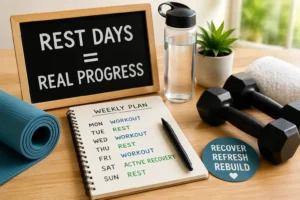
Rest days are part of progress. Your body adapts between workouts, not only during them. In its guidance on strength training, Mayo Clinic recommends training major muscle groups at least twice a week rather than pushing the same muscles every day.
If soreness is already making you second-guess your routine, why you’re sore after working out can help you understand what normal post-workout soreness usually feels like. If you’re trying to decide whether to train or rest, should you work out when sore can help you judge when it makes sense to keep going and when it’s smarter to ease off.
A simple beginner workout schedule

Here are a few realistic ways to set up the week.
If you’re completely new, start here
If you’ve not exercised consistently in a long time, do not overcomplicate the first week.
A simple starting week can look like this:
- Day 1: full-body strength
- Day 2: rest or walking
- Day 3: light cardio
- Day 4: rest
- Day 5: full-body strength
- Day 6: walking or stretching
- Day 7: rest
This is enough for a real beginner. You can always do more later. Starting with less and staying consistent is usually better than starting too hard and quitting.
Option 1: 3-day beginner plan
Monday: Full-body strength
Wednesday: Full-body strength
Friday: Full-body strength
This is one of the best setups for most true beginners because it’s simple, repeatable, and easy to recover from.
Option 2: 4-day beginner plan
Monday: Strength
Tuesday: Cardio
Thursday: Strength
Saturday: Cardio or light activity
This works well for beginners who want a little more structure without overdoing it.
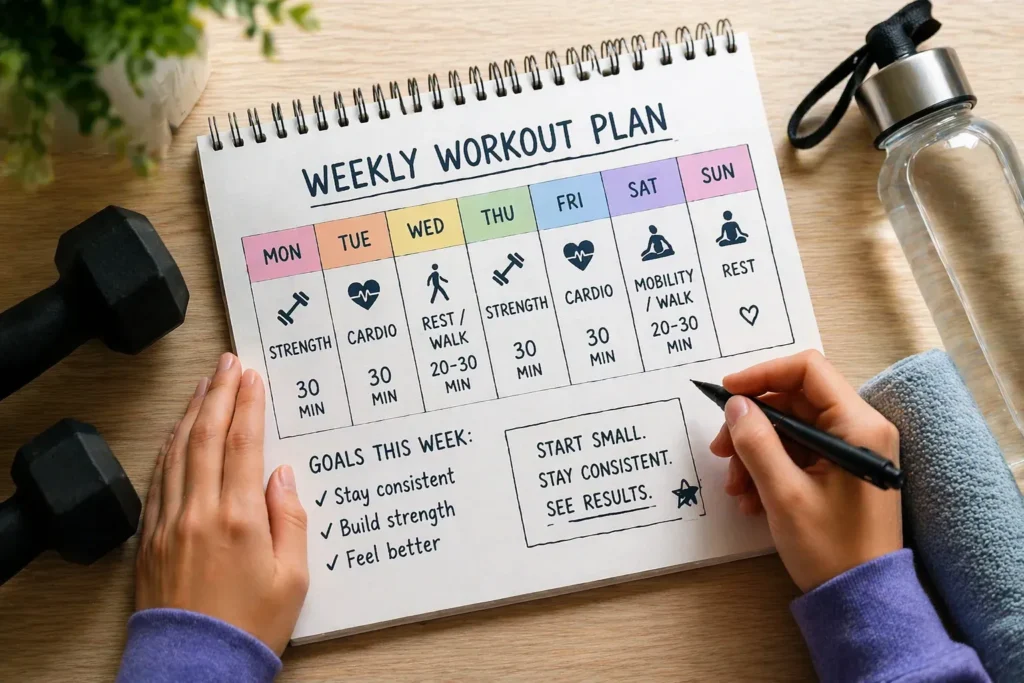
Option 3: 5-day lighter-mix plan
Monday: Strength
Tuesday: Easy cardio
Wednesday: Rest or light movement
Thursday: Strength
Friday: Easy cardio
Saturday: Mobility or walking
Sunday: Rest
This can work if the sessions stay balanced and not every day feels hard.
Best workout frequency by goal
Not every beginner is working out for the same reason.
For general health
A routine of 3 to 4 workout days a week is usually enough for general health. This fits well with guidance from the CDC and the NHS, which recommends at least 150 minutes of moderate activity and at least 2 days of strength work each week.
For building muscle
Beginners usually do well with 2 to 3 strength sessions a week, especially with full-body routines. In its strength training guide, Mayo Clinic notes that even two or three short sessions each week can improve strength significantly.
For weight loss
If your goal is weight loss, you may eventually need more total activity than someone training only for general health. The WHO says adults can increase moderate activity up to 300 minutes a week for additional health benefits. Mayo Clinic also explains in its guidance on fitness training that higher weekly activity may help with weight loss or keeping weight off.
Even then, beginners shouldn’t jump straight into an aggressive schedule. For most beginners, a moderate routine done consistently works better than an intense routine that falls apart after two weeks.
A better starting point is:
- 2 to 3 strength sessions a week
- 2 to 4 cardio sessions a week
- extra walking when possible
This is easier to maintain, and consistency is usually what drives results.
How long should beginners work out?
Most beginners do well with 20 to 45 minutes per session.
You don’t need long, exhausting workouts to make progress. Shorter sessions are often easier to recover from and easier to keep doing. The CDC notes that weekly activity can be spread out in smaller chunks. Mayo Clinic also states in its strength training advice that many adults can make real gains with short sessions done consistently.
A simple guide looks like this:
- 20 to 30 minutes for a beginner strength session
- 20 to 40 minutes for moderate cardio
- shorter sessions on busy days if that helps you stay consistent
How do you know if you’re doing too much?
You may be doing too much if:
- you feel exhausted most of the time
- your soreness keeps getting worse instead of easing
- your motivation crashes
- your sleep gets worse
- your performance starts dropping
- every workout feels heavy in a bad way
Signs your workout schedule may be too aggressive
Your schedule may be too much for now if:
- you’re still very sore when the next workout comes around
- you start skipping workouts because you feel drained
- your motivation drops after only a week or two
- you feel like every session is something to survive instead of something you can repeat
- you keep telling yourself you’ll “catch up later”
In many cases, the problem is not laziness. The problem is that the routine was too ambitious from the start.
Some soreness is normal when you begin. Constant fatigue is different. This is where many beginners go wrong. They assume more workouts automatically mean faster progress.
A lot of beginners also panic when results come more slowly than they expected. In many cases, the issue is not that the routine is failing. The issue is that the timeline was unrealistic. How long does it take to build muscle? A realistic timeline for beginners explains what progress usually looks like, which can make it easier to stay patient and avoid doing too much too soon.
Is working out every day bad for beginners?
Not always. But it depends on what “working out” means.
Doing some kind of activity every day can be healthy. The NHS encourages adults to stay active daily, but that is very different from doing hard workouts every day. For most beginners, high-intensity training seven days a week is usually too much.
A daily routine can still work if the effort changes from day to day. You might do strength on Monday, walk on Tuesday, do cardio on Wednesday, stretch on Thursday, and lift again on Friday. That’s very different from doing intense sessions every single day.
What if you miss workouts?
Missing a workout is normal. Missing a few workouts does not erase your progress either.
The bigger problem is often the reaction that follows. Many beginners miss a couple of sessions, feel guilty, and then stop altogether. A better response is simpler:
- restart with your next planned session
- do not punish yourself with extra workouts
- keep the routine manageable
- focus on consistency, not perfection
This is one reason a realistic 3-day or 4-day routine often works better than an overly ambitious plan that collapses after two weeks.
Common mistakes beginners make
Starting with too many days
Many beginners think more is always better. It usually isn’t.
Doing only cardio
Cardio helps, but it should not replace strength work. The CDC recommends muscle-strengthening activity at least 2 days a week, which is one reason a beginner plan should include both.
Skipping rest
Rest helps your body recover and adapt. Without enough recovery, consistency often falls apart.
Changing the plan every week
You need repetition to improve. A simple routine you actually follow beats a complicated one you keep restarting.
Expecting results too fast
Fitness changes take time. If your expectations are too aggressive, frustration builds fast. This is also where how long does it take to build muscle? A realistic timeline for beginners becomes useful, because it shows that visible progress usually takes longer than most beginners expect.
When should a beginner increase workout frequency?
You can think about adding more workout days when:
- your current routine feels manageable
- recovery feels good
- soreness settles faster
- your energy stays stable
- the routine no longer feels overwhelming
A common sign you’re ready is when your current 3-day routine feels normal instead of draining. At that point, adding a fourth day may make sense.
When to be careful
Speak with a healthcare professional before starting a new exercise routine if you:
- have heart disease
- get chest pain or shortness of breath with activity
- feel dizzy during exercise
- have an injury that affects movement
- have a major medical condition and have not exercised for a long time
The NHS advises checking with a doctor first if you have medical concerns or have not exercised for some time.
The bottom line
Most beginners should work out 3 to 4 times a week.
For most people, this is enough to improve strength, support general health, and recover properly. A routine with 2 to 3 strength sessions, 2 to 3 cardio sessions, and 1 to 2 easier or rest days is a strong place to start. If you’re unsure where to begin, start with 3 days a week and keep the routine simple for a few weeks before deciding whether to add more. You don’t need to train every day. You need a plan you can stick with, and the CDC’s activity guidance supports that kind of weekly structure.
Medical disclaimer: This article is for educational purposes only and does not replace medical advice, diagnosis, or treatment. If you have a medical condition, symptoms during exercise, or concerns about starting a workout routine, speak with a qualified healthcare professional.