
Written by: Martins Cornelius
Medically reviewed by: Dr. Henry Oliver
Last reviewed: March 22, 2026
Building muscle takes time.
That is the honest answer.
Many beginners start working out and expect visible changes in a week or two. Then they look in the mirror, see little difference, and assume nothing is happening. But muscle growth rarely works that fast. In most cases, your body starts adapting before your eyes can clearly see the change.
A more realistic timeline is this: many people notice strength improvements within a few weeks, but visible muscle gain usually takes longer. Some experts say noticeable physical improvements can begin in about 4 to 12 weeks, while bigger visual changes often take several months of consistent training, food, and recovery, as explained by Cleveland Clinic, Mayo Clinic, and the NHS physical activity guidelines.
So if you are asking how long it takes to build muscle, the practical answer is this: you may feel stronger in 3 to 6 weeks, start noticing small physical changes in 6 to 12 weeks, and see more obvious muscle development over 3 to 6 months or longer if you train consistently, recover well, and eat properly.
Click to Jump
Quick answer: how long does it take to build muscle?
For most beginners:
- 2 to 6 weeks: early strength gains and better workout performance
- 4 to 12 weeks: small but real physical changes may begin
- 3 to 6 months: more noticeable muscle growth for many people
- 6 to 12 months: clear body recomposition is often easier to see
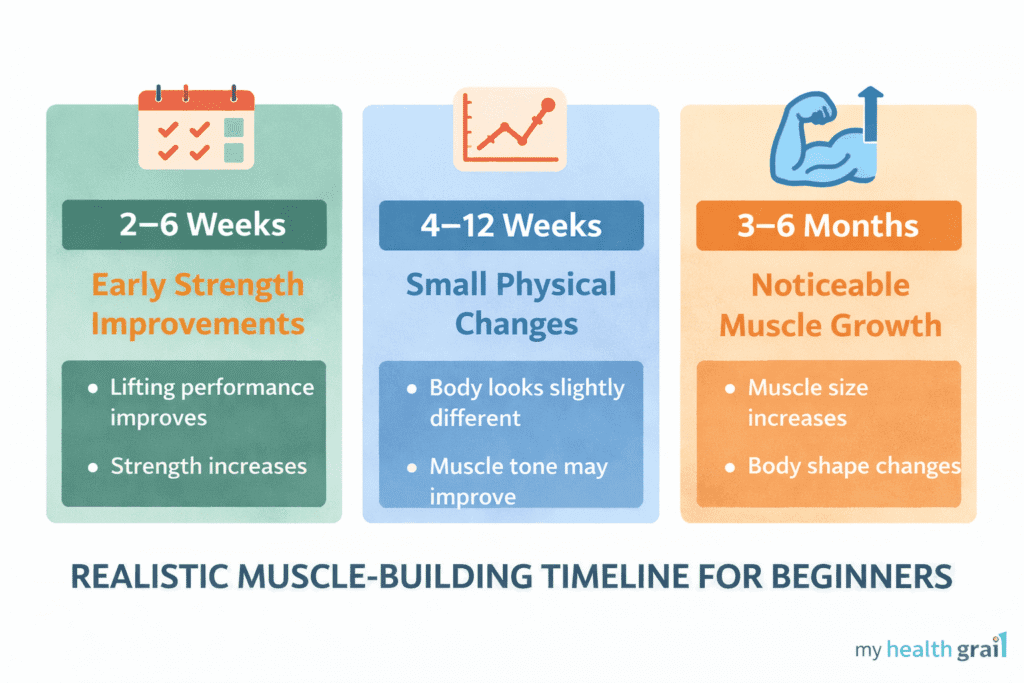
This timeline depends on your training quality, sleep, protein intake, genetics, age, stress levels, and whether you were previously active.
Why strength improves before muscle looks bigger
This is where many people get confused.
In the early stages of training, your nervous system becomes more efficient. Your body learns how to recruit muscle fibers better, control movement better, and handle resistance more effectively. That means you can get stronger before you look much more muscular. Mayo Clinic notes that you can see significant strength improvement with just two or three strength sessions a week.
So if the scale, mirror, or tape measure is not changing much yet, it does not always mean your effort is wasted. It may simply mean you are still in the early adaptation phase.
If you want to understand the science behind that process more deeply, read What Happens to Your Muscles When You Work Out, where we explained what training actually does inside muscle tissue.
A realistic muscle-building timeline for beginners
Weeks 1 to 2: your body is adjusting
At this stage, you may notice:
- soreness after workouts
- slightly better coordination
- improved energy during exercise
- small increases in strength on basic movements
You are not likely to see major visible muscle changes yet. Your body is still learning the demands of resistance training.
Weeks 3 to 6: strength starts improving
This is when many beginners begin to feel that workouts are working.
You may notice:
- better lifting performance
- more control during reps
- less exhaustion from the same workout
- early changes in muscle firmness or posture
Some people also start to look a little tighter or more athletic, especially if they are also losing body fat. But this is not always the same as large muscle gain. As Cleveland Clinic explains, strength and physical improvements can show up before dramatic visual changes.
Weeks 6 to 12: early visible changes may appear
This is the period when many beginners first notice that their arms, shoulders, chest, glutes, or legs look slightly different.
You may see:
- a little more muscle shape
- clothes fitting differently
- improved posture
- better muscle tone
- progress photos looking better than the mirror suggests
This is why progress photos and performance tracking are often more useful than daily mirror checks.
3 to 6 months: clearer muscle growth
If you have been training consistently, gradually increasing the challenge, eating enough protein, and recovering properly, this is when muscle gain often becomes much easier to notice.
At this point, you may see:
- more visible muscle size
- clearer body shape changes
- stronger lifts across multiple exercises
- a leaner appearance if body fat is also decreasing
For many beginners, this is where the work finally starts speaking loudly.
What affects how fast you build muscle?
Not everyone builds muscle at the same rate. The timeline changes based on several key factors.
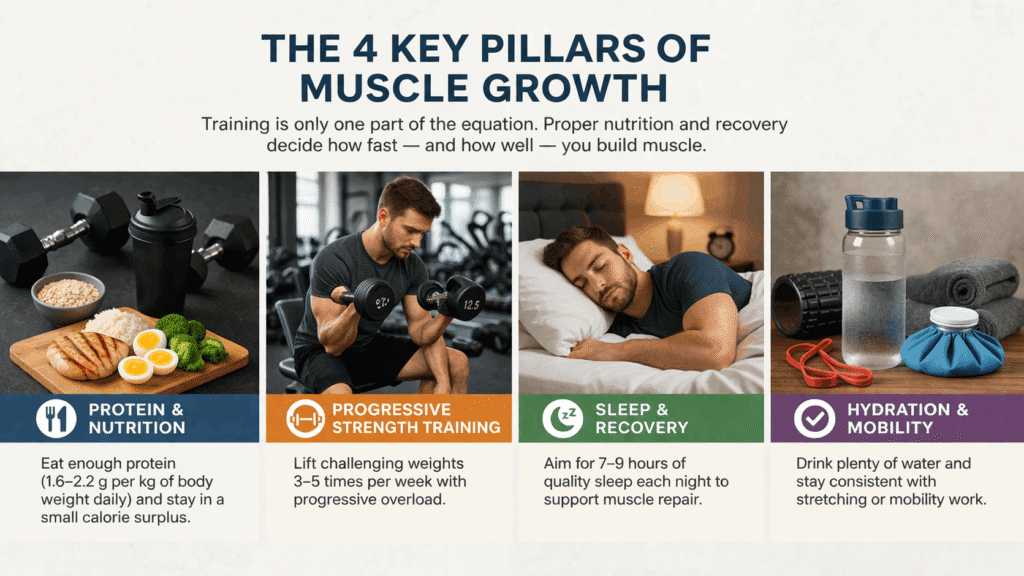
1. Your training program
You need resistance training that challenges the muscles enough to force adaptation. That can include weights, resistance bands, machines, or bodyweight exercises. The important thing is progressive overload, which means gradually making the work harder over time.
According to Mayo Clinic, strength training can build muscle efficiently even with relatively simple programming when the resistance is enough to fatigue the muscle.
2. How often you train
Adults should do muscle-strengthening activities for all major muscle groups at least two days a week, according to both the NHS physical activity guidelines and the American College of Sports Medicine. That is a strong baseline, though some people train more depending on their goals and recovery.
3. Protein and total nutrition
Your muscles need building blocks. Harvard T.H. Chan School of Public Health’s Nutrition Source explains that protein is an essential macronutrient, while Mayo Clinic’s sports nutrition guidance notes that protein after exercise supports muscle repair and growth. You also need enough total calories if muscle gain is your goal.
This is where many beginners sabotage themselves. They train hard but eat too little.
4. Recovery and sleep
Muscle is not built only in the gym. It is built during recovery.
If you train the same muscles hard every day without enough rest, progress may slow down. Mayo Clinic advises against exercising the same muscles two days in a row.
5. Body fat level
Sometimes people are building muscle, but they do not see it clearly because body fat is covering the changes. In other cases, someone who loses fat and gains a little muscle may look dramatically different even without huge muscle size gains.
6. Age, genetics, and training history
Some people respond faster than others. Genetics affect muscle shape, recovery, and growth potential. Age also plays a role, although adults of many ages can still improve strength and muscle health with resistance training, as the American College of Sports Medicine notes.
7. Consistency
This is the biggest factor of all.
A decent workout plan followed consistently will usually beat a perfect plan followed for only two weeks.
Signs you are building muscle even before it is obvious
You do not always need a dramatic mirror change to know you are progressing.
Signs include:
- you lift heavier weights than before
- you do more reps with better form
- your muscles feel firmer
- you recover better between sessions
- your posture improves
- your clothes fit differently
- progress photos show subtle changes
This is important because muscle gain often arrives quietly before it becomes visible.
Why some people think they are not building muscle
There are a few common reasons.
They expect results too fast
Social media has damaged expectations. Real muscle growth is usually slower than viral transformation videos suggest.
They keep changing their routine
A new plan every week is like digging many shallow wells and expecting water. Your body needs repeated exposure and progression.
They are not eating enough
You can train very hard and still stall if your nutrition is poor.
They do too much cardio and too little resistance training
Cardio is useful for health, but muscle growth depends heavily on resistance work.
They do not sleep enough
Recovery is part of the training process, not a bonus.
How to build muscle faster in a healthy way
You cannot force muscle overnight, but you can improve your odds.
Train consistently
Aim for at least two strength-training days per week for all major muscle groups, and more if your program is well structured and your recovery supports it, following guidance from the NHS.
Focus on progressive overload
Try to improve gradually over time by increasing reps, resistance, sets, control, or training quality.
Prioritize protein-rich meals
Include quality protein sources regularly across the day. Both Harvard Nutrition Source and Mayo Clinic support the role of protein in recovery and muscle support.
Sleep properly
Poor sleep can quietly slow progress.
Track more than the mirror
Use:
- progress photos
- workout logs
- body measurements
- strength records
- how your clothes fit
Common beginner mistake: confusing soreness with growth
Soreness can happen after a workout, especially when you are new, but it is not the same thing as muscle gain. You can build muscle without feeling extremely sore every time. You can also feel sore from a poor or unfamiliar workout that is not especially effective.
When to talk to a doctor or qualified professional
Exercise is healthy for most people, but you should get medical advice before starting or changing a workout routine if you have:
- heart disease
- uncontrolled high blood pressure
- chest pain with activity
- a major joint or back problem
- recent surgery
- dizziness or fainting with exertion
If you feel severe pain, chest tightness, fainting, or unusual shortness of breath during exercise, stop and get medical help.
Final answer
So, how long does it take to build muscle?
For most beginners, strength gains can begin within a few weeks, small physical changes may show up in about 4 to 12 weeks, and more obvious muscle growth usually takes several months of consistent work. That timeline is normal. It is not slow. It is real.
Muscle building is more like planting than flipping a switch. You prepare the ground, water it, stay patient, and let repeated effort do its work.
If you keep training, eating well, recovering properly, and staying consistent, your body will usually respond.
FAQ
You may start making internal adaptations and get a little stronger in 2 weeks, but visible muscle growth is usually limited at that stage, as Mayo Clinic explains.
Some beginners notice early changes in the arms within 6 to 12 weeks, especially if they are training regularly and eating enough protein. Bigger changes usually take longer.
The timeline can be similar to gym training if your home workouts provide enough resistance and progression. Bodyweight training, resistance bands, and dumbbells can all help build muscle when used properly, as shown in the NHS strength exercises guidance.
Yes. Three months is often enough for a beginner to build real muscle and notice visible changes, though the size of those changes varies from person to person. Cleveland Clinic supports that general timeline.
Early strength gains often come from better nervous system efficiency and improved movement skill before large visible muscle changes appear, which Mayo Clinic also explains.
Medical Disclaimer: This article is for educational and informational purposes only and is not a substitute for professional medical advice, diagnosis, or treatment. Always speak with a qualified healthcare professional about personal health concerns.