Written by: Martins Cornelius
Medically reviewed by: Dr. Henry Oliver
Last reviewed: April 2, 2026
Yes, you can sometimes work out when sore. If the soreness feels like a mild, dull muscle ache after training, light exercise is often fine. But if the pain is sharp, severe, getting worse, or changing how you move, it’s better to rest that area and avoid another hard session on the same muscles.
Most of the time, what people call normal post-workout soreness is delayed onset muscle soreness, or DOMS. It usually shows up a day or two after a new or harder workout, not during the workout itself. That’s why the real question isn’t just whether you’re sore. It’s whether what you’re feeling sounds like normal soreness or something more serious.
Click to Jump
The quick answer
If the soreness is mild and starts to ease once you warm up, you can usually still train in some way. That might mean light cardio, mobility work, a shorter session, or training a different muscle group.
If the soreness is severe, changes your form, or feels more like injury pain than muscle soreness, don’t push through it. Rest that area instead.
What soreness after a workout usually means
Normal soreness usually feels like stiffness, tenderness, or a dull ache in the muscles you trained. It often happens after a workout that was harder than usual, included unfamiliar movements, or pushed your muscles beyond what they were ready for.
If you want to understand why that ache often shows up later instead of immediately, our guide on why you’re sore after working out explains it in more detail. And if you want the bigger picture of what training actually does inside the body, what happens to your muscles when you work out breaks that down clearly.
Normal soreness may be uncomfortable, but it shouldn’t feel like sudden stabbing pain. It also shouldn’t make you think something is seriously wrong.
When it’s usually okay to work out when sore
It’s usually okay to keep moving when the soreness is mild to moderate, spread through the muscle, and starts to ease once your body warms up. As Cleveland Clinic explains in its guide to being sore after a workout, low-level soreness that improves with rest or light activity is generally normal.

This doesn’t mean repeating the same punishing workout. It usually means choosing something easier instead. A short walk, easy cycling session, gentle mobility work, a lighter workout, or a session for a different muscle group can all make sense.
For example, if your legs are sore after squats or lunges, an upper-body workout or an easy walk may be a smarter choice than another hard leg day.
When you should not work out through soreness
You should back off if the soreness is so strong that it changes your form or makes normal movement difficult. The same applies if the pain is sharp, very localized, or feels more like joint pain than muscle soreness.
Swelling, bruising, unusual weakness, or soreness that keeps getting worse are also signs to stop and reassess.
A simple rule helps here: don’t train the same sore muscles hard again right away. Most people do better when they give a worked muscle group time to recover before hitting it hard again. Mayo Clinic Health System recommends resting worked muscles for at least 48 hours before training the same muscle group again.
Mild soreness, moderate soreness, and pain that feels wrong
This is one of the most useful distinctions to make.
Mild soreness feels tight or achy, but you can still move normally. You may feel stiff at first, then better once you warm up.
Moderate soreness feels more uncomfortable and may limit performance, but you can still move with control. This is usually a sign to reduce intensity or train a different muscle group.
Pain that feels wrong is sharper, more sudden, more localized, or severe enough to change your form. That’s when you should stop treating it like ordinary soreness.
This is the difference many people are really trying to figure out when they ask whether they should work out when sore.
Don’t train the same sore muscles hard again
For most people, this is the most practical answer. If your legs are sore after squats, lunges, or hill sprints, don’t do another hard leg workout the next day. If your chest, shoulders, or triceps are sore after pressing, don’t jump into another heavy upper-body pushing session.
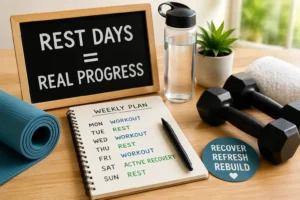
Train a different muscle group, lower the intensity, or use the day for active recovery instead.
This also helps explain why how long it takes to build muscle is measured in weeks and months, not by how wrecked you feel after one session. Progress comes from training plus recovery, not from staying sore all the time.
What kind of workout can you do when sore?
If the soreness is mild, these are usually the safest options.
Light cardio
Walking, easy cycling, or a relaxed cardio session can help reduce stiffness without putting too much stress on sore muscles.
Mobility work
Gentle movement can help you feel looser and move better. The goal is not to force painful stretching. It’s simply to keep the area moving.
A different muscle group
If your lower body is sore, you may still be fine to train upper body. If your upper body is sore, lower-body work or light cardio may make more sense.
A scaled-down session
Sometimes you don’t need to cancel the workout completely. You just need to make it easier. Less weight, fewer sets, fewer reps, or a shorter session can help you stay active without making the soreness worse.
Does soreness mean the workout worked?
Not necessarily.
You can build strength and muscle without feeling sore after every workout. Soreness is not a reliable scorecard for progress. Sometimes it simply means the workout was new, harder than usual, or something your body wasn’t used to yet.
This is important because many people start chasing soreness as proof that they trained well. But feeling sore is not the same thing as making better progress.
Soreness vs injury
Normal post-workout soreness is more likely to be dull, stiff, spread across the muscle, delayed by several hours or a day, and slightly better once you warm up.
An injury is more likely to feel sharp, sudden, concentrated in one spot, or linked with swelling, bruising, instability, or weakness.
Normal soreness usually improves over time. Injury pain often doesn’t.
When to see a doctor
Get medical advice if the pain is severe, isn’t improving after several days, keeps getting worse, or makes it hard to use the muscle normally. You should also get checked if the pain feels more like joint pain than muscle soreness, or if you notice swelling, bruising, or unusual weakness.
Get urgent medical help if you have severe muscle pain, dark urine, or unusual weakness or extreme tiredness after intense exercise, because the CDC warns that these can be signs of rhabdomyolysis.
The bottom line
So, should you work out when sore?
Yes, if the soreness is mild and you keep the session light, modified, or focused on different muscles. No, if the pain is severe, sharp, worsening, or changing how you move.
For most people, the smartest move is simple: keep moving through mild soreness, but don’t hammer the same sore muscles again before they’ve had time to recover.
Medical Disclaimer: This article is for educational and informational purposes only and is not a substitute for professional medical advice, diagnosis, or treatment. Always speak with a qualified healthcare professional about personal health concerns.