

Written by: Martins Cornelius
Medically reviewed by: Dr. Henry Oliver
Last reviewed: April 6, 2026
When you work out, your muscles don’t just get tired. They go through stress, repair, and adaptation.
Exercise challenges muscle fibers. After the workout, your body repairs that stressed tissue. Over time, this repair process helps your muscles become stronger and, in many cases, bigger. Research on muscle protein synthesis in response to exercise and nutrition shows that this repair-and-rebuild process is one of the main reasons training changes the body.
This is why one workout doesn’t transform your body overnight. But repeated workouts, followed by proper recovery, can.
If you’ve ever finished a hard session feeling sore, tired, or shaky, it can seem like your muscles are breaking down. In a sense, they’re under strain. But they’re also responding to the challenge and preparing to handle it better next time.
Click to Jump
Quick Answer
When you work out, your muscles face mechanical tension, metabolic stress, and tiny amounts of microscopic strain. After the workout, your body repairs that stressed tissue through muscle protein synthesis. With consistent training, enough recovery, and good nutrition, your muscles adapt by becoming stronger and sometimes larger.
What Happens to Your Muscles During Exercise?
Your muscles contract again and again to move your body, stabilize your joints, or resist a load. This creates stress inside the muscle.
The kind of stress depends on the workout. Resistance training creates more mechanical tension. Hard cardio and repeated movement create more fatigue and metabolic stress. The American College of Sports Medicine explains that muscles adapt when training is challenging enough and repeated consistently over time.
This is the basic reason exercise works. Your body notices the demand and starts preparing for it.
Your muscles don’t grow because exercise feels easy. They adapt because the workout gives your body a reason to improve.
Tiny Muscle Fiber Strain Is Part of the Process
One of the most important things that happens during training is small-scale stress to muscle fibers.
This isn’t the kind of damage that should scare most healthy beginners. It’s a normal part of training. As this review on exercise and muscle protein synthesis explains, hard exercise can create microscopic disruptions in muscle tissue, which then helps trigger the repair process.
This repair process is where the real change begins.
The workout is the trigger. Recovery is where adaptation starts taking shape.
Muscle Repair Starts After the Workout
Your muscles don’t rebuild while you’re still doing reps. They start recovering after the session ends.
Once the workout is over, your body begins repairing the stressed muscle tissue. It uses amino acids from protein and other nutrients to support this work. A detailed PubMed Central review on muscle protein synthesis explains that this process is one of the key drivers of adaptation after exercise.
If your body builds more muscle protein than it breaks down over time, your muscles can gradually become stronger and thicker. Thais is the basis of muscle growth.
Muscle Protein Synthesis Helps Muscles Grow
Muscle protein synthesis is one of the main reasons training can change your body over time.
After exercise, your body increases repair and remodeling activity in muscle tissue. A review on exercise-induced muscle hypertrophy shows that repeated resistance training can increase skeletal muscle mass through this ongoing repair-and-adaptation process.
This can lead to:
- improved strength
- better workout performance
- more muscle endurance
- gradual increases in muscle size
Without enough recovery, this process becomes less effective. Without enough nutrition, it becomes harder for your body to keep up.
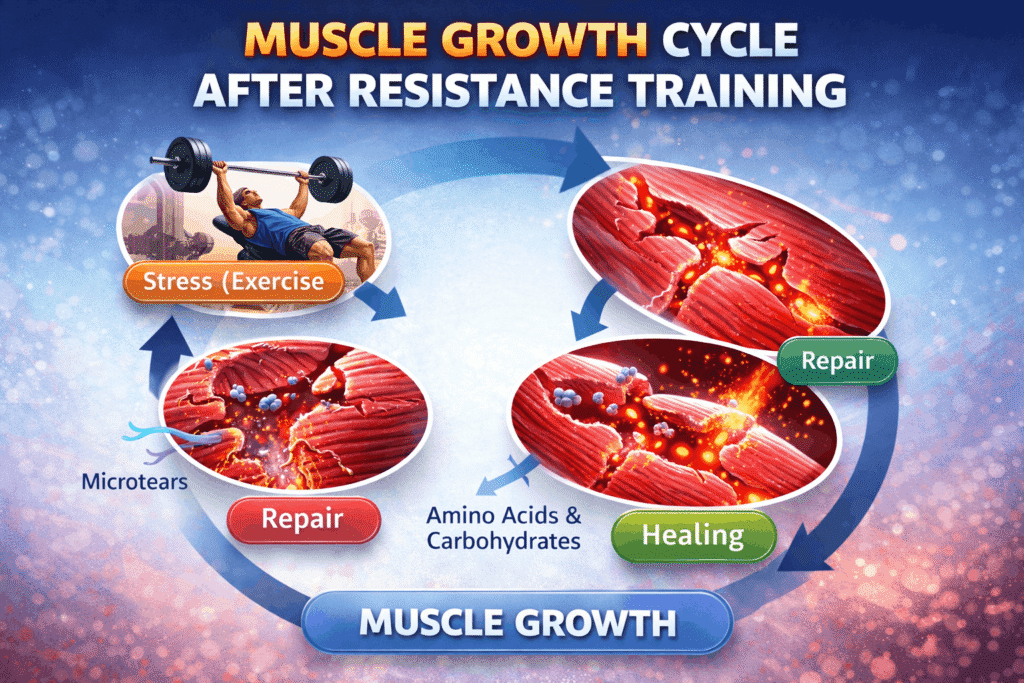
The Muscle Repair Cycle at a Glance
For most beginners, the process works like this:
workout → muscle stress → microscopic strain → recovery → repair → adaptation
This adaptation may show up as better strength, better exercise tolerance, improved performance, or gradual muscle growth.
This is also why results can feel slower than expected. The workout itself is only the first step. Your body still needs time and support to respond to it.
Your Muscles Adapt to Future Demands
Your body is efficient. It doesn’t want to be caught unprepared by the same challenge twice.
If you keep training, your body adapts by improving muscle function. In many people, it also increases muscle size over time. The American College of Sports Medicine’s resistance-training guidance makes it clear that training works best when effort, load, and progression continue to challenge the muscles.
This is why progressive overload matters. If your workouts stay too easy for too long, your muscles have less reason to adapt.
If you’re wondering when those changes usually start to show, How Long Does It Take to Build Muscle? A Realistic Timeline for Beginners explains why visible change often takes longer than people expect, even when real progress has already started.
Why Your Muscles Feel Weak or Shaky After a Hard Workout
After a tough session, your muscles may feel weak, heavy, or shaky. This usually happens because fatigue has built up and your energy stores have dropped.
During exercise, your body uses stored fuel to keep you moving. As this fuel runs low and fatigue rises, your muscles can feel less steady. It doesn’t automatically mean something is wrong. It often means the muscles were pushed hard enough to create a training response.
Still, normal fatigue is not the same thing as injury. MedlinePlus advises getting medical help if muscle symptoms come with severe swelling, worsening pain, or major difficulty moving the affected area.
Does Soreness Mean Your Muscles Are Growing?
Not always.
Soreness can happen after a new workout, a harder-than-usual session, or training that includes a lot of eccentric loading. But soreness is not a reliable sign of muscle growth.
You can build muscle without feeling very sore. You can also feel very sore without making much progress. Growth depends more on training quality, recovery, nutrition, and consistency than on how sore you feel the next day.
If soreness is something you keep trying to figure out, Why Am I Sore After Working Out? breaks down the most common reasons it happens and helps you understand when it’s expected and when it deserves more attention.
What Happens If You Don’t Rest Enough?
Muscles need time to recover.
If you train hard every day without enough sleep, rest, or nutrition, your body may struggle to repair muscle tissue properly. This can slow progress and raise the risk of fatigue, underperformance, and overtraining-type symptoms. MedlinePlus guidance on too much exercise notes that persistent signs of overtraining after rest deserve attention.
Rest isn’t laziness in fitness. It’s part of the process.
When you sleep well and allow enough recovery, your muscles are in a much better position to rebuild and adapt. And when soreness leaves you wondering whether to push through or step back, Should I Work Out When Sore? can help you make a better decision.
What This Means for Beginners
This process sounds technical, but the real-life lesson is simple.
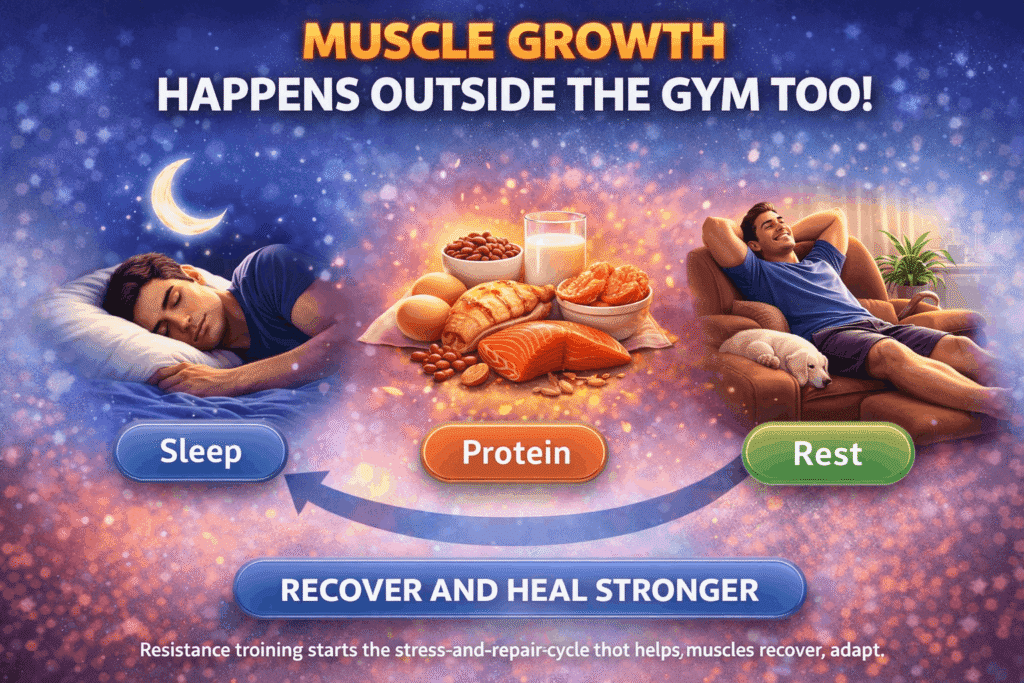
Your muscles don’t need perfect workouts. They need consistent challenge, enough food, enough sleep, and enough time to recover.
For beginners, this usually means:
- you don’t need to destroy your muscles to make progress
- soreness doesn’t prove that a workout “worked”
- strength can improve before muscle size becomes obvious
- rest days support progress rather than interrupt it
- consistent training matters more than occasional extreme effort
That last point is especially important. Many beginners make progress when they stop chasing all-out sessions and start following a smarter routine. That’s also why How Often Should Beginners Work Out? is such a useful next read, because training frequency affects how well your muscles recover, adapt, and improve.
Protein Helps Rebuild Muscle Tissue
Protein is one of the main raw materials your body uses to repair muscle after exercise.
If you work out regularly but don’t eat enough protein overall, recovery and muscle-building potential can suffer. The International Society of Sports Nutrition position stand on protein and exercise supports adequate protein intake for people who train because protein helps support muscle repair, recovery, and adaptation.
Good protein intake helps support:
- muscle recovery
- muscle maintenance
- muscle growth
- reduced muscle breakdown
This is one reason training and nutrition always go together.
Does Protein Timing Matter?
Protein timing can help, but it isn’t magic.
The International Society of Sports Nutrition review on nutrient timing notes that protein around training may support repair and remodeling, but total daily intake still matters a lot.
So yes, eating protein after a workout can be useful. But what matters most is meeting your protein needs consistently over time.
Carbohydrates are Important too
Protein gets most of the attention, but carbs matter too.
Your body uses stored carbohydrates for energy during exercise. Replacing these stores helps support recovery and future training performance. If you cut carbs too aggressively, your energy and workout quality may suffer.
For many people, the best recovery approach isn’t protein alone. It’s a balanced eating pattern that supports both tissue repair and energy replenishment.
Strength Usually Improves Before Size
A lot of beginners expect the first result of exercise to be visibly bigger muscles. That’s not usually what happens first.
In the early stages of training, many people get stronger before they look noticeably more muscular. A review on exercise, protein intake, and skeletal muscle hypertrophy explains that muscle-building depends on repeated training and recovery over time, not instant visual change.
So if you’re lifting better, moving more smoothly, or handling workouts with more control, progress is already happening even if the mirror hasn’t changed much yet.
This is one reason many people get discouraged too early. They’re improving, but they’re judging progress only by appearance. If that sounds familiar, How Long Does It Take to Build Muscle? A Realistic Timeline for Beginners can help reset expectations in a more realistic way.
Common Mistakes People Make After Working Out
A lot of stalled progress comes from what happens after the workout, not just during it.
Common mistakes include:
- training the same muscles hard every day
- eating too little overall
- not getting enough protein
- sleeping too little
- assuming soreness equals growth
- changing routines too often
- expecting visible results too fast
These mistakes don’t always ruin progress, but they can slow it. Muscles respond best when training stress is followed by enough recovery and consistency.
Consistency Is What Changes Your Muscles
One workout can challenge your muscles. Repeated workouts change them.
That’s the real answer. The body responds to repeated demand. With smart training, enough protein, good sleep, and patience, your muscles adapt over time.
This is why consistency beats random intensity in the long run.
A brutal workout done once in a while won’t do as much as a sensible plan followed week after week.
So, What Really Happens to Your Muscles When You Work Out?
Your muscles go under stress during exercise. Tiny amounts of strain can happen. Your body then repairs that tissue, strengthens it, and gradually makes it better suited for future effort. As the research on muscle protein synthesis and exercise shows, that repeated cycle of stress and repair is a core part of how muscles adapt.
This is the cycle:
stress, repair, adaptation, repeat.
The workout is the spark. Recovery is where the deeper change happens.
If you stay consistent, eat well, and allow enough rest, your muscles don’t just survive training. They learn from it.
The Bottom Line
If you’ve been asking what happens to your muscles when you work out, the simplest answer is this: they’re challenged so they can come back stronger.
Exercise places muscles under tension. Recovery helps repair them. Nutrition supports rebuilding. Over time, these can lead to better strength, better endurance, and sometimes visible muscle growth.
Your progress may feel slow at first, but that doesn’t mean nothing is happening. A lot of muscle adaptation starts below the surface before it becomes easy to see.
The important thing is not chasing the hardest possible workout. It’s giving your muscles a reason to adapt, then giving your body what it needs to follow through.
FAQ
They begin the rebuilding process after the workout, not during it. Exercise creates the stimulus. Recovery is when repair and growth happen.
It can mean your muscles were challenged, but it isn’t a reliable measure of growth or progress.
It depends on the workout, the muscle group, your sleep, your nutrition, and your training level. Some recovery starts quickly, but full recovery can take longer after hard sessions.
Recovery and rebuilding happen after training, which means rest days are part of the muscle-growth process rather than a break from it.
Yes. Especially in the early stages of training, strength often improves before visible muscle size does.
Good sleep, enough protein, enough total food, proper hydration, and appropriate rest between hard sessions all support recovery.
Protein after exercise can help support muscle repair, but total daily protein intake still matters most.
This usually happens because of fatigue, energy depletion, and the stress placed on muscle tissue during exercise.
Medical Disclaimer: This article is for educational and informational purposes only and is not a substitute for professional medical advice, diagnosis, or treatment. Always speak with a qualified healthcare professional about personal health concerns.




Pingback: How Long Does It Take to Build Muscle?