Written by: Martins Cornelius
Medically reviewed by: Dr. Henry Oliver
Last reviewed: May 1, 2026
If you’re sore after working out, the most likely reason is delayed onset muscle soreness, or DOMS. This is the muscle pain, stiffness, or tenderness that often starts several hours after exercise, peaks around 24 to 72 hours later, and then gradually fades as your body recovers.
In most cases, post-workout soreness is normal. It usually means your muscles were challenged more than they were used to, especially if you tried a new workout, trained harder than usual, returned after a break, or did exercises that involved a lot of lowering movements.
But soreness has limits. Severe pain, major weakness, swelling, dark urine, or pain that keeps getting worse should not be brushed off as ordinary workout soreness.
Click to Jump
Quick Answer
You’re probably sore after working out because your muscles experienced more stress than they’re used to. This stress can create tiny changes in the muscle fibers and surrounding tissue. Your body responds with a repair process, and that can leave the area feeling achy, stiff, tender, or heavy for a few days.
This is called delayed onset muscle soreness, or DOMS. It’s common after new, intense, or unfamiliar exercise.
You don’t need to be sore after every workout to make progress. Soreness can happen when your body is adapting, but fitness improvements come from consistent training, enough recovery, good nutrition, and gradual progression.
What Is DOMS?
DOMS stands for delayed onset muscle soreness. It’s soreness that shows up after exercise instead of during the workout itself.
It often happens after:
- starting a new workout routine
- lifting heavier than usual
- doing more reps or sets than normal
- returning to exercise after a break
- running downhill
- doing squats, lunges, push-ups, deadlifts, or other high-effort moves
- training a muscle in a way it’s not used to
According to the Cleveland Clinic’s explanation of delayed onset muscle soreness, DOMS is common after challenging your muscles and usually appears one to three days after intense exercise.
This delay is one of the biggest clues.
If the pain starts hours later and feels like a dull ache or stiffness, it may be normal soreness. If the pain starts suddenly during the workout and feels sharp, tearing, or severe, it may be an injury.
Why Does Soreness Peak 24 to 72 Hours After Exercise?
Workout soreness can feel confusing because it often doesn’t hit immediately. You may finish your workout feeling fine, then wake up the next morning stiff. Sometimes it feels even stronger two days later.
This delayed pattern is typical of DOMS.
Soreness often peaks around 24 to 72 hours after exercise because your body is responding to the stress placed on the muscle. The discomfort is linked to the repair and adaptation process that happens after training, not just what you feel during the workout.
This is one reason a hard leg day may feel worse the next morning than it did while you were training.
Why Does Muscle Soreness Happen After a Workout?
You Did More Than Your Body Was Ready For
The most common reason is simple: your workout was more than your body was recently prepared to handle.
That could mean:
- heavier weights
- more reps
- more sets
- longer workout time
- a faster pace
- less rest between sets
- a new exercise
- a different movement pattern
A workout doesn’t have to be “extreme” to make you sore. It only has to be new or harder than what your body has adapted to.
For example, if you haven’t trained your legs in weeks, a few sets of squats or lunges may leave you sore even if the workout looks moderate on paper.
You Did a Lot of Eccentric Exercise
Eccentric exercise happens when a muscle works while lengthening.
Examples include:
- lowering into a squat
- walking downstairs
- lowering a dumbbell during a biceps curl
- running downhill
- lowering your body during a push-up
- stepping down from a box
Eccentric movements are strongly linked with DOMS because they place high tension on the muscle while it lengthens. A review on PubMed about delayed onset muscle soreness discusses eccentric exercise as a common trigger.
This explains why you may feel fine during a workout but much more sore later.
You Came Back After a Break
If you stopped exercising for a while, your body may no longer be adapted to the same workout load.
A routine that once felt easy can feel challenging again after a long break. This is normal. Your strength, endurance, coordination, and tissue tolerance all need time to rebuild.
It doesn’t mean you’ve lost everything. It just means your body needs a gradual return.
You Increased Too Much Too Fast
Your body usually handles progress best in steps, not jumps.
If you suddenly double your workout volume, lift much heavier, train too many days in a row, or push through fatigue, soreness may be stronger than usual. You may also increase your risk of injury.
Mayo Clinic recommends that beginners start slowly and build up gradually, especially when starting or returning to exercise.
Is DOMS Caused by Lactic Acid?
No. DOMS is not caused by lactic acid sitting in your muscles the next day.
This is one of the most common fitness myths.
Lactic acid is involved in energy production during intense exercise, but next-day soreness is more closely linked to muscle stress and the repair response that follows. The Cleveland Clinic’s lactic acid guide explains that lactic acid buildup is not the reason your muscles ache days after exercise.
So if your legs hurt two days after squats, it’s probably not because lactic acid is still trapped there.
It’s more likely DOMS.
What Does Normal Workout Soreness Feel Like?
Normal post-workout soreness usually feels like:
- a dull ache
- stiffness
- tenderness when you press or use the muscle
- heaviness during movement
- mild temporary weakness
- reduced range of motion for a short time
It usually affects the muscles you trained. For example, your thighs may feel sore after squats, your chest may feel sore after push-ups, or your back may feel sore after rows.
Normal soreness should gradually improve over a few days. Light movement may also make you feel looser.
DOMS vs Injury: How to Tell the Difference
A lot of people asking “why am I sore after working out?” are really asking another question:
Should I be worried?
Here’s a simple way to compare normal DOMS with possible injury.
| Sign | Normal DOMS | Possible Injury |
|---|---|---|
| Timing | Starts hours later and often peaks 24–72 hours after exercise | Often starts suddenly during exercise |
| Feeling | Dull ache, stiffness, tenderness, tightness | Sharp, stabbing, tearing, popping, or severe pain |
| Location | Usually spread across the trained muscle | Often one exact spot, joint, tendon, or side |
| Movement | Light movement may help you loosen up | Movement may make it worse |
| Progress | Improves gradually over a few days | Gets worse, lingers, or limits normal movement |
| Appearance | Usually no major swelling or bruising | May include swelling, bruising, redness, or visible change |
DOMS is usually your body reacting to a training challenge. Injury is more like an alarm.
Don’t ignore the alarm.
Is It Okay to Work Out When Sore?

Usually, yes — if the soreness is mild and feels like ordinary DOMS.
You may be able to do:
- light walking
- gentle cycling
- mobility work
- stretching that feels comfortable
- a lighter version of your workout
- training a different muscle group
For example, if your legs are sore, you may train your upper body or do light movement instead of another hard leg session.
But if soreness changes your form, makes you limp, affects your joints, or gets worse with movement, rest is smarter.
A good rule is this:
If you can move well and control the exercise, light activity may be fine. If every movement feels painful or forced, recover first.
When the soreness is mild but you’re unsure whether to train or rest, this guide on whether you should work out when sore explains how to decide safely.
What Helps Sore Muscles After a Workout?
For normal DOMS, the most useful recovery steps are simple: light movement, sleep, hydration, enough food, enough protein, and reducing training intensity for a day or two.
You don’t need a complicated recovery routine.
Light Movement
Gentle movement can help reduce stiffness. Walking, easy cycling, low-intensity mobility, or a light recovery session may make your muscles feel less locked up.
A PubMed review on DOMS treatment strategies notes that people who need to keep training may reduce exercise intensity and duration for one to two days after a DOMS-inducing workout or train less affected body parts.
This means you don’t always have to stop moving completely. You just need to adjust.
Sleep
Sleep is one of the most underrated recovery tools.
Your body does a lot of repair work when you rest. If you train hard but sleep poorly, recovery may feel slower and soreness may feel more frustrating.
Good sleep will not erase DOMS instantly, but it supports the process your body is already trying to complete.
Hydration
Hydration won’t magically cure soreness, but it supports normal muscle function and recovery.
If you’re dehydrated, everything can feel harder: movement, energy, performance, and recovery.
Drink enough fluids, especially if you sweat heavily, train in hot weather, or exercise for a long time.
Sensible Nutrition

Your muscles recover better when you eat enough overall.
Protein is important because it provides building blocks your body uses for muscle repair. Carbohydrates also help refill energy stores, especially after harder training.
You don’t need a perfect diet to recover. But under-eating, skipping meals, or not getting enough protein can make your workouts feel harder and your recovery feel slower.
Massage or Foam Rolling
Massage or foam rolling may help some people feel better. They may reduce tightness or improve comfort, especially when soreness feels stiff rather than sharp.
But they’re not miracle fixes. Time, recovery, and smart training still do most of the work.
What Probably Won’t Help Much?
Some recovery tips are popular because they sound convincing, not because they always work well.
Stretching, ice, heat, massage guns, cold plunges, and supplements may help some people feel better, but they don’t always remove DOMS quickly.
It doesn’t mean they’re useless. It means you should keep expectations realistic.
For most normal soreness, the basics still win:
- move lightly
- sleep well
- hydrate
- eat enough
- reduce intensity temporarily
- give the muscle time
Recovery doesn’t have to be dramatic to work.
Is DOMS a Sign of a Good Workout?
DOMS can happen after a challenging workout, but it’s not proof that the workout was better.
You can build strength, improve fitness, and grow muscle without being sore after every session.
Soreness mostly tells you that your body faced a new or harder stress than usual. It doesn’t automatically mean you trained correctly, burned more fat, built more muscle, or made faster progress.
In fact, chasing soreness can backfire. If every workout leaves you extremely sore, you may struggle to stay consistent.
Progress comes from:
- good technique
- gradual overload
- enough recovery
- enough protein and calories
- consistent training
- patience
If your main goal is muscle growth, soreness is only one small part of the picture. How Long Does It Take to Build Muscle? explains the timeline more clearly.
Who Is More Likely to Get DOMS?
Anyone can get DOMS, but it is more common when your muscles aren’t used to the workout.
You may be more likely to feel sore if you:
- are new to exercise
- recently returned after a break
- increased workout intensity too quickly
- tried a new exercise
- trained a muscle from a different angle
- did many eccentric movements
- trained too close to failure
- skipped recovery days
- did more volume than usual
Beginners often notice soreness more because their bodies are still adapting. This does not mean beginners should avoid exercise. It means they should start with a manageable routine.
Beginners are more likely to get sore when they do too much too soon, so it’s important to start with a manageable plan like strength training at home for beginners.
Why Are My Legs More Sore Than Other Muscles?
Leg soreness can feel intense because leg workouts often involve large muscle groups and a lot of eccentric loading.
Exercises like squats, lunges, deadlifts, step-ups, and running downhill can place heavy stress on the thighs, glutes, hamstrings, and calves.
Legs also carry you through daily life. So even mild soreness may feel more noticeable when you stand, walk, climb stairs, or sit down.
This is why leg day soreness can feel personal.
When Should I Worry About Soreness?
Most workout soreness is not dangerous, but some symptoms need medical attention.
Get medical help if you have:
- severe or worsening pain
- major swelling
- significant weakness
- pain that does not start improving after a few days
- dark, tea-colored, red, or cola-colored urine
- fever or feeling very unwell
- pain after a pop, snap, or obvious injury
- loss of normal movement
- numbness or tingling
Dark urine with severe muscle pain can be a warning sign of rhabdomyolysis, a serious condition where damaged muscle tissue can affect the kidneys. MedlinePlus lists dark or cola-colored urine, weakness, muscle aching, and tenderness among possible symptoms.
Do not try to “push through” symptoms like that.
How to Prevent Getting So Sore Next Time
You may not prevent all soreness, especially when trying something new. But you can reduce how severe it gets.
Increase Gradually
Don’t go from zero to chaos.
Build your workouts step by step. Add weight, reps, sets, or intensity slowly instead of changing everything at once.
A gradual approach gives your muscles and joints time to adapt.
Stay Consistent
The body adapts to repeated training.
When you exercise regularly, the same workout is less likely to wreck you every time. This is one reason beginners often get sore at first, then notice less soreness as their bodies adjust.
Consistency doesn’t mean training hard every day. It means showing up regularly with a plan your body can recover from.
For beginners, How Often Should Beginners Work Out? gives a more practical weekly starting point.
Warm Up Before Hard Exercise
A warm-up prepares your body for harder movement. It increases blood flow, raises body temperature, and helps you move better.
A simple warm-up can include:
- easy walking
- light cycling
- arm circles
- bodyweight squats
- hip hinges
- gentle mobility drills
- lighter practice sets before lifting heavier
You don’t need a long warm-up. You need one that matches the workout you’re about to do.
Use Good Technique
Good form will not remove all soreness, but poor technique can create unnecessary strain.
If soreness always happens in one odd spot, or a specific exercise keeps causing pain, check your form. You may need to lower the weight, shorten the range of motion, slow down, or get guidance from a qualified trainer.
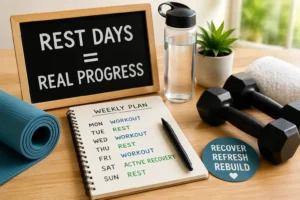
Respect Recovery Days
Recovery days are not wasted days. They’re part of the training process.
Muscles need time to adapt after stress. If you train hard every day without enough recovery, soreness may become more frequent and your performance may drop.
Good training is not only about doing more.
It’s about doing enough, recovering well, and repeating it consistently.
The Bottom Line
If you’re sore after working out, it’s usually because of delayed onset muscle soreness, or DOMS. This kind of soreness often starts several hours after exercise, peaks around 24 to 72 hours later, and improves within a few days.
It’s common after new, harder, or unfamiliar workouts, especially exercises with a lot of lowering movements.
Mild soreness is usually normal. Severe pain, swelling, major weakness, dark urine, or pain that keeps getting worse isn’t something to ignore.
You don’t need to chase soreness to make progress. Train consistently, increase gradually, recover properly, and listen when your body gives you a warning sign.
FAQ
Leg workouts often involve large muscle groups and a lot of eccentric loading. Squats, lunges, step-downs, deadlifts, and downhill running can all challenge the legs heavily. Since you also use your legs throughout the day, soreness may feel more noticeable.
No. Not being sore does not mean your workout failed. You can still build strength, improve fitness, and make progress without feeling sore after every session.
Normal DOMS usually improves within a few days. It often peaks around 24 to 72 hours after exercise, then gradually fades. If the pain keeps getting worse or does not improve, it may not be ordinary soreness.
Yes, if the soreness is mild and you can move normally. A lighter workout, active recovery, or training a different muscle group may be fine. If the pain is sharp, severe, or changes how you move, rest first.
Not necessarily. Gentle stretching may help you feel looser, but it’s not always a strong fix for DOMS. Light movement, sleep, hydration, enough food, and temporary reduction in workout intensity are usually more useful.
No. Next-day soreness is not caused by lactic acid trapped in your muscles. DOMS is more closely linked to muscle fiber stress and the repair process that follows exercise.
Not always. Soreness can happen when your muscles face a new challenge, but it isn’t required for muscle growth. Muscle growth depends more on consistent training, progressive overload, nutrition, sleep, and recovery.
Medical Disclaimer: This article is for general education only. It does not replace medical advice. See a healthcare professional if your pain is severe, unusual, worsening, or linked with swelling, weakness, fever, or dark urine.