Written by: Martins Cornelius
Medically reviewed by: Dr. Henry Oliver
Last reviewed: April 25, 2026
The best way to start strength training at home is to keep it simple. Begin with 2 to 3 full-body workouts a week, use a few basic exercises that train your whole body, and focus on form before you worry about heavy resistance. The CDC’s adult activity guidelines, the American Heart Association’s fitness recommendations, and the NHS guide to strength exercises all support regular muscle-strengthening work, including exercises you can do at home.
You do not need a home gym to begin. Bodyweight exercises, resistance bands, or a pair of dumbbells are enough for many beginners. It’s one reason home strength training remains a practical starting point for people who want to get stronger without the cost, travel, or intimidation that can come with a gym.
Click to Jump
Quick answer
If you’re a beginner, start strength training at home by doing:
- 2 to 3 workouts a week
- 5 to 6 basic exercises
- 1 to 3 sets per exercise
- 8 to 12 controlled reps
- at least 1 rest day between hard full-body sessions
A simple beginner workout can include squats, glute bridges, push-ups or incline push-ups, rows, overhead presses, and planks. You do not need fancy equipment. You need a routine you can repeat consistently.
Before your first workout
Before you start:
- wear stable shoes or train barefoot only on a safe, non-slip surface
- clear enough floor space to move comfortably
- start with easier exercise versions
- stop if you feel sharp pain, chest pain, or dizziness
This kind of simple setup helps beginners train more safely and with more confidence, especially at home. Major health organizations also emphasize matching exercise to your current ability and building up gradually.
What is strength training?
Strength training means making your muscles work against resistance.
The resistance might come from:
- your body weight
- resistance bands
- dumbbells
- kettlebells
- weighted household items
The goal is not to make the workout look impressive. The goal is to challenge your muscles enough that they gradually adapt and get stronger. What happens to your muscles when you work out explains what’s actually happening inside the muscle after training.
Can beginners really build strength at home?
Yes, they can.
For beginners, home strength training can work very well because early progress usually comes from learning movement, training consistently, and giving the muscles a reason to adapt. The American Heart Association’s strength training guidance makes clear that resistance training is a real part of a healthy routine. The CDC’s physical activity guidance includes bodyweight work, weights, and resistance bands as muscle-strengthening activity.
This means home workouts still count when they are challenging enough and repeated consistently. As long as your muscles are being trained with structure and progression, you can absolutely build strength at home.
Why home strength training is a good starting point
Home training works especially well for beginners because it removes a lot of friction.
You don’t need to:
- travel to a gym
- wait for equipment
- know how to use many machines
- compare yourself with other people
- commit to a complicated program right away
For many people, the best beginner plan is the one that feels easiest to start and easiest to repeat.
How often should beginners strength train at home?
Most beginners do best with 2 to 3 strength workouts a week.
That’s enough to train regularly without making recovery too difficult. The CDC, WHO, and the American Heart Association all recommend muscle-strengthening work on at least 2 days a week, which fits well with a beginner plan built around two or three sessions.
If you want a fuller breakdown of weekly frequency, how often should beginners work out? helps you see how strength sessions, cardio, and rest can work together in one realistic week.
How long should a beginner strength workout be?
For most beginners, 20 to 45 minutes is enough.
You don’t need marathon workouts. A shorter session done well and repeated every week is usually more useful than one long session that leaves you wiped out. The CDC’s advice on adding physical activity also supports the idea that activity can be built into manageable chunks instead of needing one long block every time.
What equipment do you need?
You can start with almost nothing.
Option 1: bodyweight only
This is the cheapest and simplest starting point.
You can train with:
- squats
- glute bridges
- lunges
- incline push-ups
- planks
- hip hinges
- wall sits
Option 2: resistance bands
Bands are beginner-friendly, portable, and useful for rows, presses, pull-aparts, and lower-body work.
Option 3: a pair of dumbbells
If you can afford one thing, this is often the most flexible option.
A pair of light-to-moderate dumbbells can cover:
- goblet squats
- Romanian deadlifts
- rows
- overhead presses
- floor presses
- loaded carries
You do not need a perfect setup before you begin.
The best types of exercises to start with
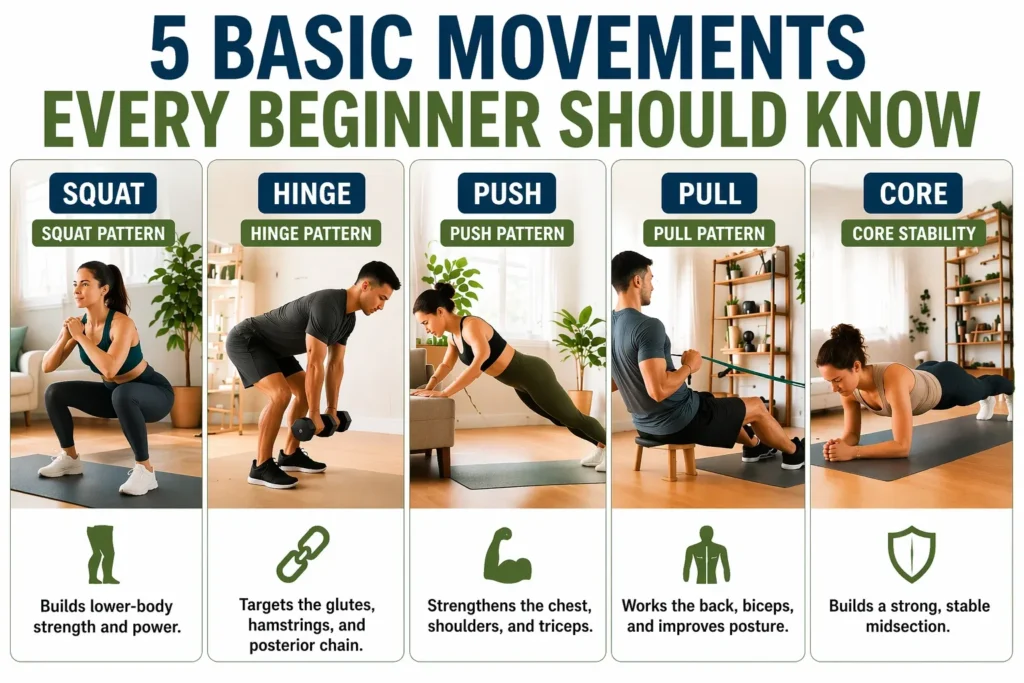
A beginner home routine should focus on basic movement patterns, not random isolated exercises.
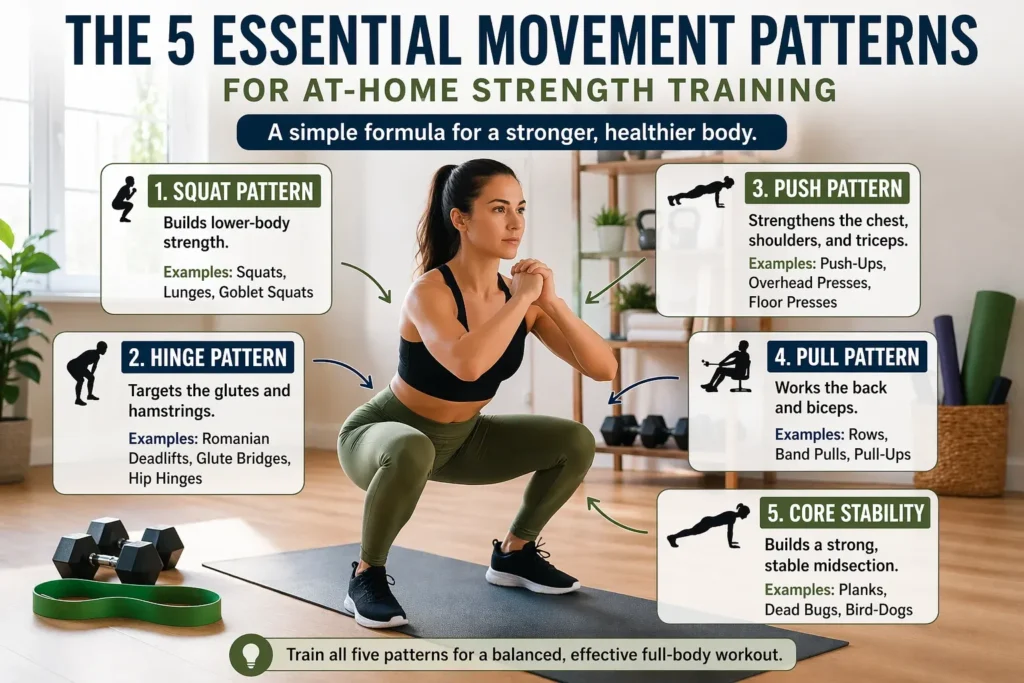
Try to include these:
1. Squat pattern
This trains the legs and lower body.
Examples:
- bodyweight squat
- chair squat
- goblet squat
2. Hinge pattern
This trains the glutes and hamstrings.
Examples:
- glute bridge
- hip hinge drill
- Romanian deadlift
3. Push pattern
This trains the chest, shoulders, and triceps.
Examples:
- wall push-up
- incline push-up
- dumbbell floor press
- overhead press
4. Pull pattern
This trains the back and biceps.
Examples:
- band row
- one-arm dumbbell row
- towel row if safe and stable
5. Core stability
This helps you brace and control movement.
Examples:
- plank
- dead bug
- bird-dog
A simple routine built around these patterns is usually better than a flashy workout with too many exercises.
A simple beginner strength training plan at home
Here’s a practical full-body plan for true beginners.
Workout A
- Bodyweight squat or goblet squat — 2 to 3 sets of 8 to 12 reps
- Glute bridge — 2 to 3 sets of 10 to 15 reps
- Incline push-up or wall push-up — 2 to 3 sets of 6 to 12 reps
- One-arm dumbbell row or band row — 2 to 3 sets of 8 to 12 reps per side
- Plank — 2 to 3 rounds of 15 to 30 seconds
Workout B
- Reverse lunge or split squat — 2 to 3 sets of 6 to 10 reps per side
- Romanian deadlift with dumbbells or a backpack — 2 to 3 sets of 8 to 12 reps
- Dumbbell overhead press — 2 to 3 sets of 8 to 12 reps
- Band row or dumbbell row — 2 to 3 sets of 8 to 12 reps
- Dead bug — 2 to 3 sets of 8 to 10 reps per side
You can alternate them like this:
- Monday: Workout A
- Wednesday: Workout B
- Friday: Workout A
The next week, start with Workout B.
This kind of full-body setup is simple, repeatable, and beginner-friendly.
A simple 4-week beginner schedule
This makes the plan easier to follow when you’re just starting.
Week 1
Do 2 workouts this week.
Use 1 to 2 sets per exercise.
Keep the effort moderate and focus on learning the movements.
Week 2
Do 2 workouts again.
Use 2 sets per exercise.
Try to move more smoothly and with better control.
Week 3
Move up to 3 workouts if recovery feels okay.
Use 2 to 3 sets per exercise.
Keep at least one rest day between harder sessions.
Week 4
Stay with 3 workouts.
Add a few reps, a little resistance, or a slightly harder variation for one or two exercises.
This kind of gradual build-up matches how major public health guidance encourages people to increase activity over time instead of jumping in too hard.
How hard should the workout feel?
It should feel challenging, but not sloppy.
A useful beginner rule is this: finish most sets feeling like you could still do 1 to 3 more reps with good form.
This means:
- the set was not too easy
- the set was not so hard that your technique collapsed
- you still gave the muscles a reason to adapt
You don’t need to train to failure on every set.
How to warm up before strength training at home
Keep your warm-up short and specific.
Start with 5 to 10 minutes of easy movement such as:
- marching in place
- arm circles
- bodyweight squats
- hip hinges
- shoulder rolls
- light reps of the first exercise
The point is to prepare the joints and muscles for the workout, not to tire yourself out before it starts.
How to progress once the workout feels easier
Progressive overload means gradually asking your body to do a little more over time.
At home, that can mean:
- adding reps
- adding a set
- slowing the lowering phase
- improving range of motion
- using a harder exercise variation
- adding resistance with bands, dumbbells, or a loaded backpack
You don’t need to change everything at once. One small increase is enough.
For example:
- Week 1: 2 sets of 8 squats
- Week 2: 2 sets of 10 squats
- Week 3: 3 sets of 10 squats
- Week 4: goblet squats with a dumbbell
This is still progress.
How long does it take to see results?
Beginners often notice better coordination and early strength gains within a few weeks. While visible muscle changes usually take longer. This is one reason many people quit too soon. They expect visual change before the body has had enough time to adapt.
If you want a more realistic picture of that timeline, our article on how long it takes to build muscle helps set expectations without the usual hype.
What if you feel sore?
Some soreness can be normal, especially when you are new, returning after a break, or doing movements your body is not used to yet. Many beginners feel it more the day after the workout than during the workout itself, which is one reason delayed soreness can be confusing at first.
That said, you don’t need to chase soreness to make progress. Why Am I Sore After Working Out? explains what normal post-workout soreness usually feels like. And Should I Work Out When Sore? can help you decide when to keep moving and when to back off.
Common beginner mistakes
Starting too hard
A lot of beginners do too much in week one.
They choose too many exercises, too many sets, and too many workout days. These usually lead to soreness, frustration, or inconsistency.
Changing the plan too often
You don’t need a new workout every few days.
Beginners usually make better progress when they repeat the same key lifts long enough to improve at them.
Ignoring form
Poor technique makes the workout less effective and can raise injury risk.
Start with movements you can control well.
Doing only abs or arms
A beginner routine should train the whole body.
A few visible muscles should not take over the whole program.
Thinking home workouts do not count
They do count.
If the muscles are challenged, the training is structured, and the routine is repeated consistently, it counts.
Should beginners do cardio too?
Yes, but cardio doesn’t have to replace strength work.
A balanced week can include both. The CDC’s activity guidelines and the American Heart Association’s recommendations both support combining aerobic activity with muscle-strengthening work rather than relying on only one type of exercise.
A simple weekly setup might look like this:
- Monday: Strength
- Tuesday: Walk or easy cardio
- Wednesday: Strength
- Thursday: Rest or light movement
- Friday: Strength
- Saturday: Walk, cycling, or mobility
- Sunday: Rest
When should I be careful?
Speak with a healthcare professional before starting if you:
- have chest pain with activity
- get dizzy when exercising
- have a major heart or lung condition
- have a recent injury
- have not exercised in a long time and have medical concerns
This is especially important if exercise symptoms feel unusual or severe. Public health recommendations consistently support adapting activity to your health status and getting medical advice when symptoms or conditions make exercise less straightforward.
The bottom line
The best way to start strength training at home for beginners is to keep the plan simple enough that you’ll actually stick with it.
Start with 2 to 3 full-body workouts a week. Use a few basic exercises. Focus on form. Let the workouts feel challenging, but manageable. Then build gradually.
You don’t need a perfect body, perfect equipment, or a perfect routine before you begin.
You just need a starting point you can repeat next week.
FAQs
Yes. Bodyweight exercises can be enough for a true beginner, especially at first. Over time, you may want more resistance, but you don’t need weights to start.
Yes. A focused 20-minute full-body workout can be enough for a beginner, especially when done consistently.
Most beginners do well with about 5 to 6 exercises in one session, especially if those exercises train the whole body.
Usually no. Most beginners do better with 2 to 3 strength sessions a week and rest or lighter movement between them. The CDC’s adult activity guidance recommends muscle-strengthening work on at least 2 days a week, not necessarily every day.
Yes. Beginners can build strength and muscle at home if the workouts are challenging enough, repeated consistently, and supported by recovery and enough good food.
Medical disclaimer: This article is for educational purposes only and does not replace medical advice, diagnosis, or treatment. If you have a medical condition, exercise symptoms, or concerns about starting a workout routine, speak with a qualified healthcare professional.