
Written by: Precious Eze
Medically reviewed by: Dr. Deborah Akinlola
Last reviewed: April 28, 2026
Yes, steroids can sometimes increase the risk of a yeast infection. They don’t cause one in every woman, and they’re not the only possible trigger. But steroid medicines can make yeast overgrowth more likely in some cases. The CDC notes that corticosteroids can increase the risk of candidiasis.
That said, steroids usually raise risk indirectly, not in the same way a direct irritant would. Yeast called Candida already lives in the body in small amounts. Trouble starts when that balance shifts and the yeast grows too much. If you develop itching, soreness, burning, or a thick white discharge after starting steroid treatment, the medicine could be part of the picture. But it’s still important not to self-diagnose too quickly because other problems can look similar. As ACOG, the CDC, and the NHS explain, yeast infections can overlap with other causes of vaginal symptoms.
Click to Jump
How steroids can raise yeast infection risk
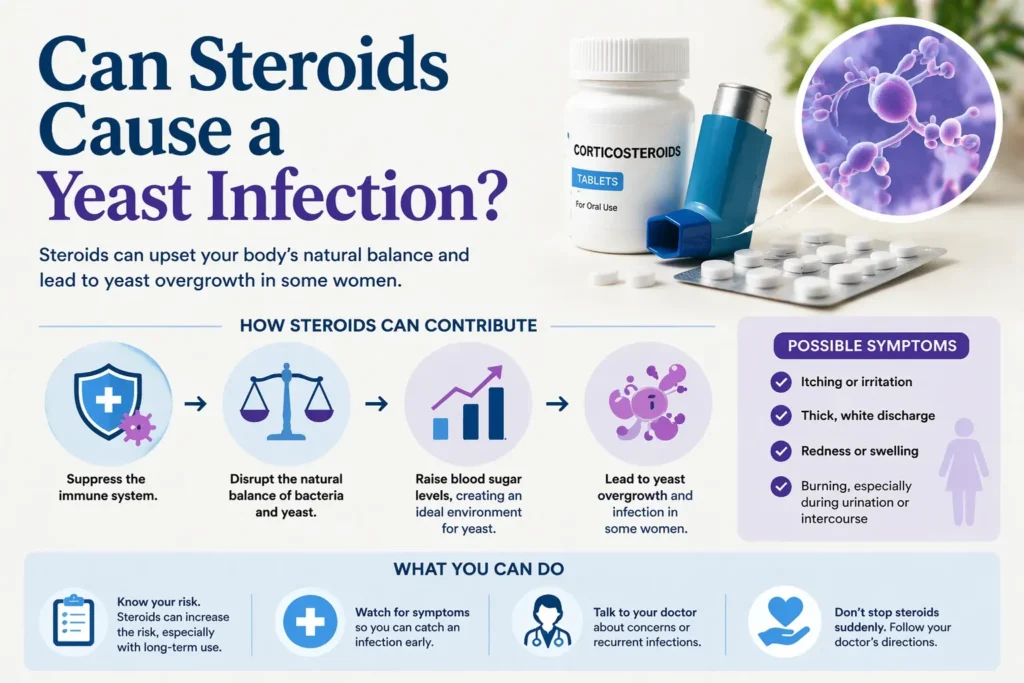
Steroids, also called corticosteroids, can reduce inflammation and calm an overactive immune response. That’s why they’re used for problems like asthma, severe allergies, autoimmune conditions, eczema flares, and some inflammatory illnesses. But the same immune-suppressing effect that helps treat those conditions can also make it easier for yeast to overgrow in some people. The CDC is clear that antibiotics and corticosteroids can increase the risk of candidiasis.
This doesn’t mean every short course of steroids will lead to a vaginal yeast infection. In many women, it won’t. Risk tends to go up more when steroids are stronger, used for longer, used repeatedly, or combined with other risk factors such as antibiotics, diabetes, pregnancy, hormone changes, or a weakened immune system. The CDC lists antibiotics, hormone changes, and weakened immunity among important candidiasis risk factors.
Which steroids are most likely to be involved?
The steroid category is broad. It includes:
- Oral steroids, such as prednisone or methylprednisolone
- Injected steroids
- Inhaled steroids, often used for asthma
- Topical steroid creams or ointments
In general, oral and injected steroids are more likely to affect the whole body than creams used on one small area. So they’re more often the ones people worry about in relation to yeast overgrowth. Inhaled steroids are well known for increasing the risk of oral thrush, especially if the mouth isn’t rinsed after use. Mayo Clinic notes that medicines such as prednisone and inhaled corticosteroids can raise the risk of thrush by disturbing the body’s normal microbial balance.
That doesn’t prove every vaginal yeast infection after steroid use came from the medicine itself. But it does support the wider point that steroids can make fungal overgrowth more likely in some situations.
What symptoms should you watch for?
A vaginal yeast infection often causes:
- itching or irritation in and around the vagina
- soreness or burning
- pain during sex
- stinging or discomfort when you pee
- a thick white discharge that may look clumpy
The CDC lists vaginal itching or soreness, pain during sex, pain when urinating, and abnormal discharge as common symptoms. ACOG also notes that burning can feel worse with urination or sex. The NHS describes typical thrush symptoms as itching, irritation, soreness, and white discharge that often does not smell.
If your symptoms started soon after a steroid course, the timing may be relevant. But symptoms alone still don’t prove the cause. This is true if you also have a strong odor, gray discharge, green discharge, bleeding, pelvic pain, or fever. Because these signs can point away from a simple yeast infection and toward something else.
Steroids aren’t the only possible cause
This is where a lot of women get misled. They start a steroid, notice vaginal symptoms, and assume the medicine must be the whole explanation. Sometimes it is. Sometimes it isn’t.
Yeast infections can also happen with no obvious trigger. And many other conditions can mimic them. For example, bacterial vaginosis and some sexually transmitted infections can cause discharge, irritation, burning, or discomfort. The NHS vaginitis guide explains that different causes of vaginitis can produce overlapping symptoms, which is one reason self-diagnosis can go wrong.
Antibiotics are still one of the best-known medicine-related triggers for yeast overgrowth, so the picture can get more confusing when steroid treatment and antibiotics overlap. It’s one reason many women also ask whether antibiotics can trigger the same problem, which is covered in Can Antibiotics Cause a Yeast Infection? What Women Should Know. A broader look at how different medicines can affect vaginal health gives more context. And if your symptoms feel more like dryness, friction, or discomfort than classic yeast infection symptoms, finding out if antihistamines cause vaginal dryness or if antidepressants cause vaginal dryness may help you compare them more clearly.
What should you do if you think steroids triggered it?
Don’t stop a prescribed steroid on your own unless a clinician tells you to. Some steroids need to be tapered, and some are treating conditions that can get worse if you stop suddenly.
1. Look at the symptoms
If the main symptoms are itching, soreness, burning, and thick white discharge, a yeast infection becomes more likely. BV may be a better fit instead if there’s a fishy odor or thin gray discharge. It becomes easier to spot once you understand how BV differs from yeast overgrowth, which is explained in Can Antibiotics Cause Bacterial Vaginosis?
2. Consider timing
Did symptoms start during the steroid course or soon after? Did they happen during the same period as antibiotics? Or did you recently have another risk factor, such as uncontrolled blood sugar, pregnancy, or immune suppression? Timing doesn’t confirm the diagnosis, but it can help the bigger picture make sense.
3. Get checked if you’re not sure
The CDC notes that treatment is usually an antifungal cream or a dose of fluconazole, but it also explains that testing is recommended before starting treatment. This is important because many women treat themselves for yeast when the real cause is something else.
4. Avoid common irritation triggers while symptoms are active
Perfumed washes, scented pads, vaginal deodorants, and harsh soaps can make things worse. The NHS advises avoiding irritating products around the vulva and vagina when symptoms are active.
When should you see a doctor?
You should get medical advice sooner if:
- this is your first suspected yeast infection
- symptoms are severe
- symptoms keep coming back
- you’re pregnant
- you have diabetes or a weakened immune system
- you’re using repeated or long-term steroid treatment
- symptoms don’t improve with treatment
- you’re not sure it’s really a yeast infection
This becomes even more important if you develop fever, pelvic pain, unusual bleeding, sores, or strong odor. Those features deserve a proper evaluation because they’re not classic signs of uncomplicated vaginal candidiasis. The CDC’s treatment guidance and ACOG both support proper evaluation when symptoms are unclear or recurrent.
Can you prevent it if you need steroids?
Sometimes, yes, at least partly.
You may not be able to avoid the steroid itself if it’s medically necessary. But you can lower the chance of extra irritation and catch symptoms earlier.
Helpful steps include:
- use the medicine exactly as prescribed
- tell your doctor if you’ve had recurrent yeast infections
- rinse your mouth after inhaled steroids to lower the risk of oral thrush
- avoid unnecessary antibiotic use
- keep diabetes well managed if that applies to you
- avoid scented vaginal products when symptoms start
The CDC advises using antibiotics and corticosteroids exactly as directed and telling a healthcare provider if symptoms develop.
FAQ: Steroids and Yeast Infections
Yes, prednisone can raise the risk of a yeast infection in some women because it can reduce immune defenses and make yeast overgrowth easier. The risk may be higher if you also have other triggers, such as antibiotics, diabetes, or repeated steroid use.
It can in some cases, especially if the steroid effect is strong enough to affect the body more broadly. It won’t happen to everyone, but if symptoms start soon after a steroid injection, it’s reasonable to consider the medicine as one possible factor.
Usually, steroid creams used on a small external area are less likely to affect the whole body than oral or injected steroids. But if a steroid cream is used around the genital area without the right diagnosis, it can sometimes worsen irritation or make a fungal problem harder to recognize.
There’s no single timeline. Some women notice symptoms during treatment or soon after. Others may never develop one at all. Timing alone doesn’t prove the cause, but symptoms that begin during or after steroid use deserve attention.
No. Don’t stop a prescribed steroid on your own unless your doctor tells you to. Some steroids need to be tapered. Stopping them suddenly may cause other problems. It’s better to get checked and confirm what’s causing the symptoms.
The bottom line
Steroids can sometimes increase the risk of a yeast infection, especially when other risk factors are present. They do this by making fungal overgrowth easier in some situations, not by directly causing infection in every woman who takes them. The risk becomes more believable when symptoms begin during or soon after steroid treatment and fit the usual yeast infection pattern.
Still, don’t assume every vaginal symptom after steroids is thrush. BV, irritation, dryness, and other infections can look similar. It’s better to get checked and treat the right problem, if you’re unsure.
Medical disclaimer: This article is for educational purposes only and isn’t a substitute for medical advice, diagnosis, or treatment. If your symptoms are severe, recurrent, or unclear, see a qualified healthcare professional.