Written by: Abiola Johnson
Medically reviewed by: Dr. Joan Chika
Last reviewed: April 3, 2026
A strong fishy vaginal smell usually means something is off. As WomensHealth.gov explains in its bacterial vaginosis overview, bacterial vaginosis (BV) is the most common cause. CDC’s trichomoniasis guide shows that trichomoniasis can also cause unusual vaginal odor.
Click to Jump
Quick answer
If your vagina smells fishy, BV is the most likely cause. WomensHealth.gov notes that the odor linked to BV can become more noticeable after sex. CDC’s trichomoniasis page shows that trichomoniasis can cause odor too. A yeast infection is far less likely to cause a fishy smell.
Is any vaginal smell normal?
Yes. The vagina can have a mild natural scent, and that scent can shift a little around your period, after sweating, or after sex. But a strong fishy odor is not the same as a mild natural vaginal scent. As Mayo Clinic’s vaginal odor overview makes clear, a strong unusual odor can point to a condition that needs attention, especially when it comes with discharge, irritation, or a change in your usual vaginal pattern.
The most common reason: bacterial vaginosis
BV is the most common cause of a fishy vaginal smell. It happens when the normal balance of bacteria in the vagina changes. Many people with BV notice a thin white or gray discharge and a smell that becomes stronger after sex. This same symptom pattern is described by WomensHealth.gov. A pattern that is typical of bacterial vaginosis, especially when a fishy smell is the first symptom someone notices.
Another possible cause: trichomoniasis
A fishy smell can also happen with trichomoniasis, which is a sexually transmitted infection. CDC’s trichomoniasis guidance notes that it can cause discharge along with itching, burning, soreness, or pain during urination or sex. Because smell alone cannot tell you exactly what is causing the problem, it helps to understand how yeast infection vs BV vs STI symptoms can overlap but still point to different causes.
Can a yeast infection cause a fishy smell?
Usually, no. Yeast infections are much more likely to cause itching, soreness, irritation, and a thick discharge than a strong fishy odor. This is why a fishy smell points more strongly toward BV or trichomoniasis than toward yeast. This is also why knowing what a vaginal yeast infection usually feels like can help, since yeast is much more likely to cause itching and irritation than a fishy smell.
Why it may smell stronger after sex
If the smell gets stronger after sex, BV becomes even more likely. WomensHealth.gov describes this as one of the classic patterns linked to BV, even though it does not confirm the diagnosis on its own.
Other possible causes of unusual vaginal odor
Although BV is the main cause of a fishy smell, it’s not the only possible reason for unusual vaginal odor. A forgotten tampon, irritation from scented products, and trichomoniasis can also cause odor changes, as explained in Mayo Clinic’s summary of vaginal odor causes.
This is important because some people assume every odor problem is BV when it’s not.
Symptoms that should make you pay attention
A fishy smell deserves more attention when it happens with:
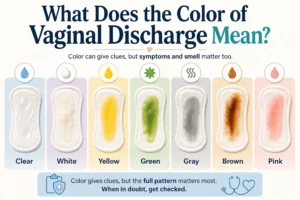
- thin white or gray discharge
- yellow, green, or frothy discharge
- itching or irritation
- burning when you pee
- pain during sex
- pelvic discomfort
- symptoms that keep returning
A fishy smell often shows up with discharge changes, which is why it also helps to know when vaginal discharge is abnormal.
Can you treat it at home?
It’s better not to guess. BV and trichomoniasis need the right diagnosis because they are treated differently. CDC’s BV treatment guidelines show why guessing with a random yeast treatment at home is not the right approach.
Because symptoms can overlap, ACOG’s vaginitis guidance supports getting checked instead of trying to self-diagnose based on odor alone.
What not to do
Do not douche in an attempt to get rid of the smell. WomensHealth.gov’s douching guide explains that douching can disrupt the vaginal environment and make problems worse. It’s also best to avoid scented sprays, washes, or deodorizing products inside the vagina, since they can irritate the area and make the real cause harder to spot.
When to see a doctor
You should get checked if the smell is strong, new, keeps returning, or comes with unusual discharge, itching, burning, soreness, pain during sex, or discomfort when you pee. This is made clear in ACOG’s guidance on vaginitis symptoms that need evaluation. You should also get checked if symptoms began after a new sexual partner, if you may have been exposed to an STI, if you are pregnant, or if you also have pelvic pain, fever, or bleeding.
Red flags you should not ignore
Seek prompt medical care if the odor comes with pelvic pain, fever, bleeding, severe pain, pregnancy-related concerns, or strong STI concern. These symptoms should not be brushed off or repeatedly self-treated at home. ACOG’s vaginitis guidance supports prompt evaluation when symptoms are severe or persistent.
FAQ
Yes. A fishy smell is one of the most common symptom patterns linked to BV. WomensHealth.gov notes that many people notice it more after sex.
This pattern is commonly associated with BV. It does not prove BV by itself, but WomensHealth.gov identifies it as a common clue.
Usually not. A fishy smell points more strongly toward BV or trichomoniasis than toward a yeast infection.
Yes. Mayo Clinic lists a retained tampon as one possible cause of unusual vaginal odor. So it should not be overlooked.
The bottom line
If your vagina smells fishy, BV is the most likely cause. But trichomoniasis and a few other problems can also be responsible. Do not assume it’s yeast, and do not try to mask the smell with scented products. If the odor is new, keeps coming back, or shows up with discharge, irritation, burning, or pain, get checked so the real cause can be treated properly.
Medical Disclaimer: This article is for educational and informational purposes only. It is not a substitute for professional medical advice, diagnosis, or treatment. Always speak with a qualified healthcare professional about personal health concerns.