Written by: Abiola Johnson
Medically reviewed by: Dr. Joan Chika
Last reviewed: April 18, 2026
Vaginal itching can happen for several reasons, and a yeast infection is only one of them. ACOG, Mayo Clinic, and Cleveland Clinic all explain that itching can also happen because of irritation, bacterial imbalance, some infections, skin conditions, or low estrogen.
If the itching is mild and goes away quickly, simple irritation may be the cause. But if it lasts, keeps coming back, or comes with discharge, odor, burning, sores, rash, or pain, you shouldn’t assume it’s yeast.
Click to Jump
Quick answer
The most common causes of vaginal itching include yeast infection, irritation from soaps or scented products, bacterial vaginosis, some STIs, skin conditions, and hormone-related dryness. The right treatment depends on the real cause. This is why treating every itch like a yeast infection can delay proper care, as Mayo Clinic’s vaginitis overview and Cleveland Clinic’s itchy genitals guide make clear.
Does vaginal itching always mean a yeast infection?
No. A yeast infection often causes itching, but itching doesn’t always mean yeast.
A vaginal yeast infection often causes itching, burning, soreness, and sometimes a thick white discharge. But Cleveland Clinic’s vulvar dermatitis page explains that irritation or allergic reactions around the vulva can also cause itching, and ACOG’s vulvar disorders guide shows that several non-yeast causes can look similar.
This is where self-diagnosis gets tricky. If you’re trying to work out whether your symptoms sound more like yeast, BV, or an STI, Yeast Infection vs BV vs STI: How to Tell the Difference can help you compare those patterns before you jump to conclusions.
Common causes of vaginal itching
Yeast infection
Yeast infection is one of the most common causes of vaginal itching. It often causes itching around the vagina or vulva, burning, redness, soreness, and sometimes a thick white discharge. That symptom pattern is consistent with guidance from Mayo Clinic and Cleveland Clinic.
If the itching feels intense and comes with irritation or a thicker white discharge, the symptom pattern may be closer to what’s explained in Vaginal Yeast Infection: Symptoms, Causes, Treatment, and Prevention.
Irritation from soaps, pads, wipes, or scented products
This is very common, and it’s easy to miss.
The skin around the vulva is sensitive. Scented washes, sprays, wipes, detergents, pads, panty liners, and tight clothing can all irritate the area. Cleveland Clinic’s vulvar dermatitis article says the vulva can become itchy and inflamed after contact with an irritant or allergen, and its itchy vagina explainer also points to fragranced hygiene products as common triggers.
This kind of itching often comes with redness, dryness, stinging, or a raw feeling instead of the more classic yeast pattern. If the itching started after you changed a wash, detergent, pad, or wipe, irritation becomes much more likely.
Bacterial vaginosis
Bacterial vaginosis, or BV, is more strongly linked to discharge and a fishy odor than to intense itching. Still, some people do notice irritation or discomfort. Mayo Clinic notes that BV can cause vaginal discomfort, and ACOG’s vulvovaginal health page describes the typical odor-and-discharge pattern.
If itching comes with a fishy smell, Why Does My Vagina Smell Fishy? will help make sense of that odor pattern. And if you want the fuller picture on the condition itself you should look at Bacterial Vaginosis: Symptoms, Causes, Treatment, and Prevention.
STIs
Some sexually transmitted infections can cause itching, burning, irritation, sores, blisters, or unusual discharge. Mayo Clinic’s overview of what’s typical and what’s not notes that STIs can affect the vagina and may cause discharge or genital sores, while ACOG’s vulvar disorders guide includes infections such as genital herpes among possible causes of vulvar itching.
You should be more cautious if the itching comes with sores, blisters, pelvic pain, bleeding, painful urination, or a recent new sexual exposure. In that situation, it’s safer not to guess.
Skin conditions
Sometimes the problem is more about the skin around the vulva than the vagina itself.
Skin conditions can cause ongoing itching, burning, irritation, and repeated flare-ups. ACOG and Cleveland Clinic both describe dermatitis and other vulvar skin disorders as common causes of these symptoms.
This becomes more likely if the skin looks dry, thickened, cracked, or irritated, or if yeast treatment hasn’t helped.
Low estrogen or dryness
Hormone-related dryness can also cause itching and irritation. This can happen around menopause, while breastfeeding, or during other times when estrogen levels are lower. Mayo Clinic’s vaginitis page and its vaginal atrophy page both note that reduced estrogen can lead to dryness, burning, and itching.
If the itch comes with dryness and very little discharge, this may be more likely than an infection.
What your symptoms may suggest
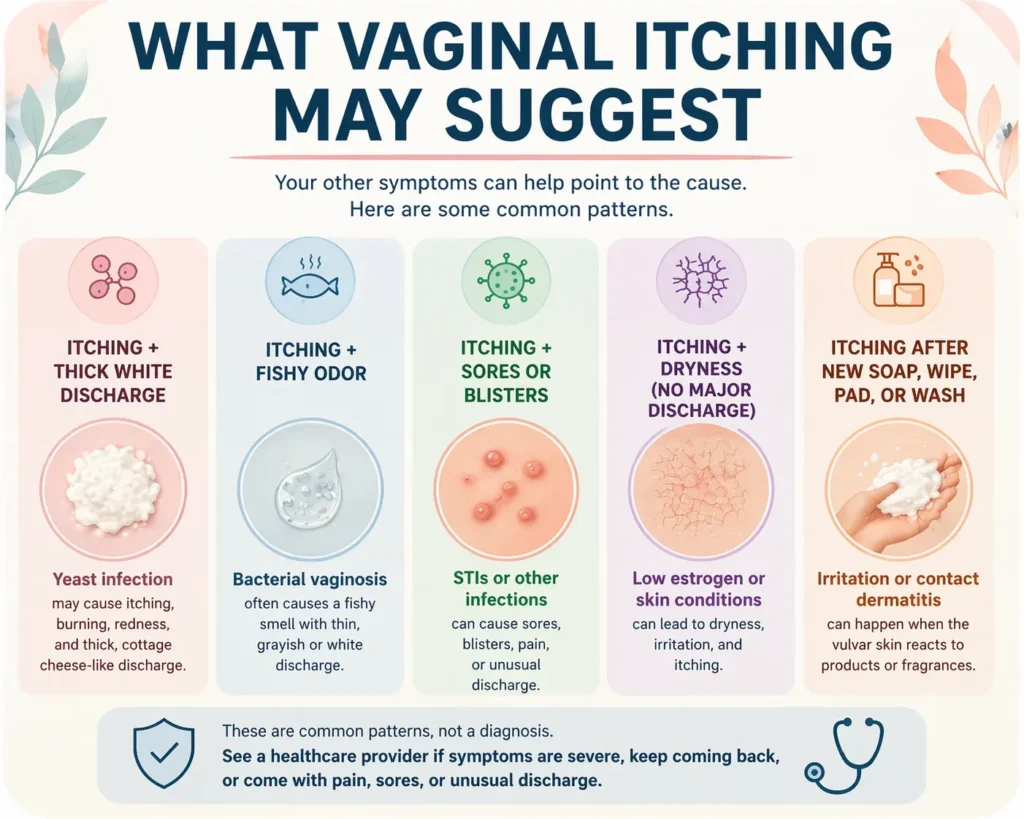
Itching with thick white discharge
Yeast infection becomes more likely.
Itching with fishy odor
BV may be more likely than yeast.
Itching with sores, blisters, or strong pain
You need medical evaluation because an STI or another condition may be involved.
Itching after a new soap, wipe, pad, or wash
Irritation or contact dermatitis becomes more likely.
Itching with dryness and no major discharge
Low estrogen or skin irritation may be part of the problem.
If itching happens along with a noticeable change in discharge, it helps to look at the discharge itself instead of focusing on the itch alone. What Causes Vaginal Discharge and When Is It Abnormal? provides a clearer pattern for this cause. And if the color has changed too, What Does the Color of Vaginal Discharge Mean? can help you understand what that extra clue may or may not mean.
What you can do at home
If the itching is mild and you don’t have red-flag symptoms, these steps may help:
- stop using scented products around the vulva
- avoid douching
- wear loose cotton underwear
- change out of sweaty clothes quickly
- wash gently with warm water
- avoid harsh scrubbing
- don’t keep self-treating unless you’re fairly sure it’s yeast
As Cleveland Clinic explains, avoiding irritants can help calm vulvar skin. ACOG also notes that persistent symptoms need proper evaluation rather than repeated guessing.
What not to do
Don’t assume every itch is a yeast infection.
That can lead to the wrong treatment, delayed relief, and missed causes such as BV, irritation, or an STI. It can also make recurring symptoms harder to understand. If you’ve treated yourself more than once and the itching keeps coming back, it’s smart to stop guessing and get checked.
When to see a doctor
See a doctor if this is your first episode and you’re not sure what’s causing it. You should also get checked if the itching is severe, keeps coming back, comes with sores or blisters, or happens with pelvic pain, fever, bleeding, unusual discharge, or a strong odor. Mayo Clinic’s yeast infection treatment page notes that people who aren’t sure they really have a yeast infection should be evaluated instead of repeatedly self-treating.
You should also get medical advice if over-the-counter yeast treatment doesn’t help or if symptoms return soon after treatment.
Can vaginal itching go away on its own?
Sometimes it can. Mild irritation may improve once the trigger is removed. But Cleveland Clinic says that if genital itching gets worse or lasts for a long time, you should get medical care because the cause may need treatment.
FAQ
No. Yeast is one common cause, but irritation, BV, some STIs, skin conditions, and low estrogen can also cause itching. That’s why the full symptom pattern matters more than the itch alone, as ACOG and Mayo Clinic both make clear.
It may point more toward irritation, a skin condition, or hormone-related dryness than a classic yeast infection. That said, some infections can still start with itching before discharge becomes obvious. Cleveland Clinic and Mayo Clinic both support those non-discharge causes.
Nighttime itching can feel worse simply because there are fewer distractions, but persistent itching still needs the same careful approach. If it keeps happening, don’t assume it’s yeast without looking at the rest of your symptoms.
Yes. Scented soaps, sprays, wipes, detergents, pads, and other fragranced products can irritate the vulva and trigger itching or burning. Cleveland Clinic directly describes that irritant pattern.
You should get checked if the itching is severe, keeps coming back, or comes with sores, blisters, pain, bleeding, strong odor, unusual discharge, or pelvic pain. That’s also the safer move if you’re not sure whether you really have a yeast infection, which is the approach supported by Mayo Clinic.
The bottom line
Vaginal itching can happen for many reasons, and yeast is only one of them. The full symptom pattern matters more than the itch alone. If the itching comes with unusual discharge, odor, burning, sores, or repeat flare-ups, it’s safer to get checked than to guess.
Medical disclaimer: This article is for general education only. It doesn’t replace medical advice, diagnosis, or treatment. If you have severe pain, fever, sores, bleeding, pelvic pain, or symptoms that keep returning, get medical care.